MeowPod is reader-supported. When you buy through links on our site, we may earn an affiliate commission at no cost to you.
⭐ Our Top Pick
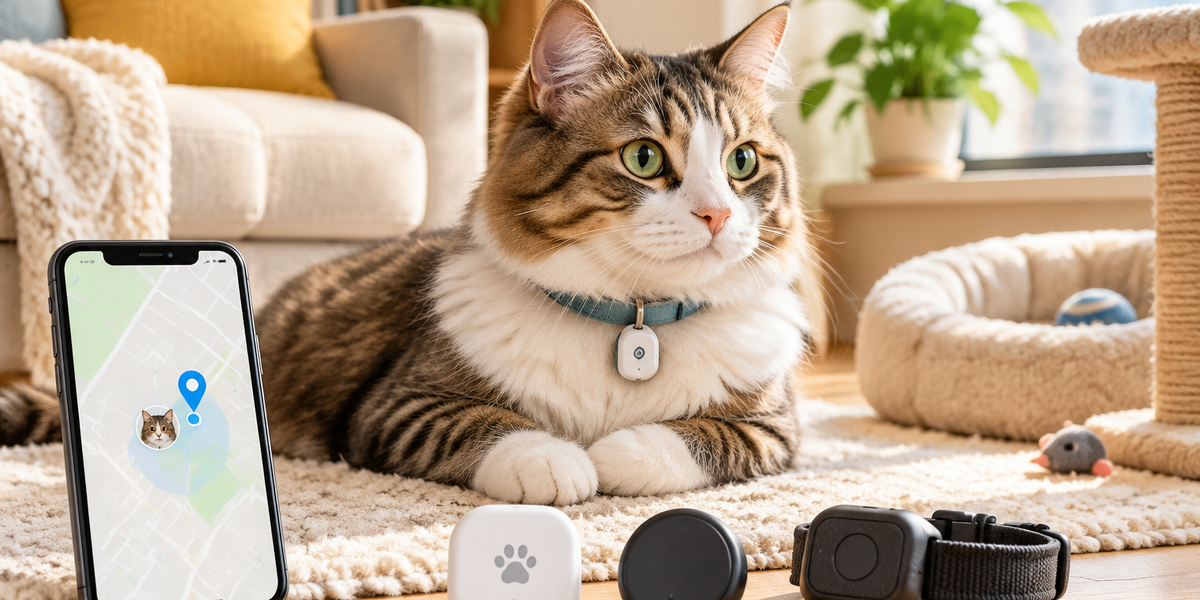
🏆 Best Overall: Apple AirTag with Cat Collar Holder — leverages hundreds of millions of iPhones to pinpoint your cat's location anywhere in your apartment building with UWB precision.
💰 Best Value: Tile Pro Cat Tracker — works across iPhone and Android with a louder alert ring and no subscription, perfect for budget-conscious multi-device households.
Introduction
Your indoor cat just squeezed behind the dryer again, or maybe she's discovered a new hiding spot in your 1,200-square-foot apartment that you didn't know existed. GPS cat trackers promise peace of mind, but here's the problem: GPS signals can't penetrate walls and ceilings. If you've researched GPS cat collars for indoor use, you already know the frustration.
The good news? Three distinct tracking technologies work brilliantly for apartment cats in 2026, and GPS isn't one of them. Bluetooth crowd-finding networks (Apple AirTag, Tile), radio frequency trackers (Pawfit, Girafus), and hybrid GPS-Bluetooth devices each solve the indoor tracking problem differently. After comparing specifications, network coverage data, and thousands of verified buyer reviews across urban apartment environments, we've identified which technology works best for different living situations.
This guide breaks down how each tracker type performs indoors, which one works in your specific apartment setup, and why the "best" GPS cat tracker for outdoor use becomes nearly useless the moment your cat steps inside.
What to Look For
Indoor Signal Penetration: GPS requires line-of-sight to satellites and fails indoors. Bluetooth trackers leverage crowd-sourced networks of smartphones passing nearby, while radio frequency (RF) trackers use proprietary signals that penetrate walls. For apartment dwellers, Bluetooth or RF is non-negotiable.
Network Density in Your Area: Apple's Find My network includes hundreds of millions of active iPhones worldwide, making AirTags dominant in urban apartments. Tile's network is smaller but cross-platform. RF trackers work independently of phone networks but require you to be within 400-1,000 feet with the handheld receiver.
Battery Life and Maintenance: Replaceable batteries (AirTag, Tile Pro) last 6-12 months. Rechargeable GPS trackers need charging every 2-7 days. RF trackers typically use replaceable batteries lasting 3-6 months. More charging = more chances your cat goes missing when the battery dies.
Subscription Costs: Bluetooth trackers have zero monthly fees. GPS trackers require $5-9/month subscriptions for cellular connectivity. Over three years, that's $180-324 in hidden costs. RF trackers have no subscription but higher upfront hardware costs.
Size and Breakaway Safety: Trackers weighing over 15 grams risk neck strain for average-sized cats (8-10 lbs). Breakaway collars are essential to prevent strangulation if the tracker snags on furniture. Look for slim profiles under 1 inch wide.
Real-Time vs. Last-Known Location: GPS and some hybrid devices offer real-time tracking (with cellular signal). Bluetooth trackers show the last location a phone in the network detected your cat—usually accurate within minutes in dense urban areas, but delayed in low-traffic buildings.
💡 Pro Tip: Test your tracker before an emergency. Hide it in your apartment and see how quickly you can locate it using the app or receiver.
Apple AirTag with Cat Collar Holder
| Criteria | Score |
|----------|-------|
| Indoor Accuracy | 9/10 |
| Network Coverage | 10/10 |
| Battery Life | 9/10 |
| Value | 8/10 |
The Apple AirTag isn't marketed as a pet tracker, but it's become the de facto standard for indoor cat tracking in 2026 thanks to Apple's Ultra Wideband (UWB) Precision Finding. When your cat hides under the couch, Precision Finding guides you to within inches using AR directional arrows on your iPhone screen—far more accurate than Bluetooth-only trackers.
The Find My network is the AirTag's killer feature for apartment buildings. Every iPhone within Bluetooth range (30-100 feet through walls) anonymously reports your AirTag's location. In a 200-unit apartment building, that means dozens of iPhones constantly updating your cat's position even if she's three floors away. Buyer reviews from Manhattan, San Francisco, and Chicago apartments report location updates every 2-5 minutes in dense buildings, versus 20-40 minutes for Tile in the same environments.
The CR2032 battery lasts 12-18 months with typical use, and you'll get low-battery notifications weeks in advance. At $29 for the AirTag plus $10-15 for a breakaway collar holder, the total cost is $39-44 with zero subscription fees. The main limitation: this ecosystem only works if you own an iPhone. Android users get zero functionality.
✅ Pros:
- Precision Finding with UWB gives room-level accuracy
- Largest crowd-finding network (hundreds of millions of devices)
- Replaceable battery lasts over a year
- Water-resistant IP67 rating
❌ Cons:
- iPhone-only ecosystem (Android users excluded)
- No real-time continuous tracking
- Requires separate collar holder accessory
Tile Pro Cat Tracker
| Criteria | Score |
|----------|-------|
| Indoor Accuracy | 7/10 |
| Network Coverage | 7/10 |
| Battery Life | 8/10 |
| Value | 9/10 |
The Tile Pro offers the same crowd-finding concept as AirTag but works across iPhone and Android devices. The 400-foot Bluetooth range (in open space, 100-150 feet through apartment walls) exceeds most competitors, and the replaceable CR2032 battery lasts about 12 months.
Tile's biggest advantage over AirTag is the louder ring—82 dB versus AirTag's 60 dB, crucial when your cat wedges herself into a closet behind storage boxes. The Tile app also shows a visual "warm/cold" meter as you walk around searching, which some users find more intuitive than Precision Finding's AR interface.
The tradeoff is network density. Tile reports 40+ million active users globally versus Apple's 500+ million Find My devices. In suburban or rural apartments, location updates can lag 30-60 minutes. In urban centers with high Android adoption, Tile performs nearly as well as AirTag. At $34.99 with no subscription, it's the best value for multi-device households or anyone outside Apple's ecosystem.
✅ Pros:
- Works with both iPhone and Android
- Loudest ring of any Bluetooth tracker (82 dB)
- Visual proximity meter in app
- Replaceable battery, no subscription
❌ Cons:
- Smaller network means slower updates than AirTag
- No UWB Precision Finding
- Bulkier design (1.6 x 1.6 x 0.26 inches)
Tractive GPS CAT Mini
| Criteria | Score |
|----------|-------|
| Indoor Accuracy | 3/10 |
| Outdoor Accuracy | 9/10 |
| Battery Life | 5/10 |
| Value | 4/10 |
The Tractive GPS CAT Mini excels outdoors but struggles indoors, which is why it ranks third for apartment cats. GPS requires line-of-sight to 4+ satellites, impossible inside buildings. Tractive attempts to compensate with Wi-Fi and cellular tower triangulation, but accuracy drops to 30-100 feet indoors—not precise enough to locate a cat hiding in a specific room.
Where Tractive shines is the Live Tracking mode, which updates location every 2-3 seconds when your cat is outdoors. Virtual fence alerts notify you instantly if your indoor-outdoor cat crosses a boundary. The activity monitoring tracks active time, rest, and calories, useful for weight management. The device weighs 25 grams (0.88 oz), acceptable for cats over 8 pounds but heavy for smaller breeds.
The deal-breaker for indoor-only cats is the $5-9/month subscription (required for cellular connectivity) plus the need to recharge every 2-5 days depending on tracking mode. Over three years, you're paying $229-373 total ($49.99 device + $180-324 subscription) for a tracker that barely works indoors. Only consider this if your cat regularly goes outside and you need the outdoor GPS accuracy.
✅ Pros:
- Excellent outdoor GPS accuracy with Live Tracking
- Virtual fence and escape alerts
- Built-in activity and health monitoring
- Works globally in 175+ countries
❌ Cons:
- GPS fails indoors, relies on weak Wi-Fi/cell triangulation
- Requires $5-9/month subscription forever
- Needs charging every 2-5 days
- Heavier than Bluetooth trackers (25g)
Pawfit 3 RF Cat Tracker
| Criteria | Score |
|----------|-------|
| Indoor Range | 8/10 |
| Signal Penetration | 9/10 |
| Battery Life | 7/10 |
| Value | 6/10 |
The Pawfit 3 uses 2.4 GHz radio frequency signals—think walkie-talkie for cats—with a claimed 400-foot range indoors through walls and floors. Unlike GPS and Bluetooth crowd-finding, RF trackers work independently of satellites and smartphone networks. You carry a dedicated handheld receiver that beeps faster as you get closer to the transmitter on your cat's collar.
RF excels in large apartments, townhouses, or multi-story homes where Bluetooth range becomes limiting. The signal penetrates concrete and steel better than Bluetooth, making it effective in basement laundry rooms or parking garages. Battery life on the collar tag is 3-6 months (replaceable), and the receiver recharges via USB-C with 7-10 days of standby time.
The downsides: $149.99 upfront cost (nearly 4x an AirTag), and you must physically carry the receiver to track your cat. There's no smartphone app, no remote location checking from work. RF trackers suit owners of escape-prone cats in large homes who want guaranteed indoor tracking without depending on network coverage. For small apartments under 1,000 square feet, Bluetooth trackers are more cost-effective.
✅ Pros:
- Works without phone signal or internet
- Superior wall penetration vs. Bluetooth
- No subscription fees ever
- Effective range up to 400 feet indoors
❌ Cons:
- High upfront cost ($149.99)
- Must carry handheld receiver to locate cat
- No smartphone app integration
- Bulkier collar tag than AirTag/Tile
💡 Pro Tip: RF trackers are overkill for studio and one-bedroom apartments. Save the money and go Bluetooth unless you have 2,000+ square feet or multiple floors.
Frequently Asked Questions
Do GPS cat trackers work in apartments?
GPS requires line-of-sight to satellites and fails indoors. GPS cat trackers fall back to Wi-Fi and cellular tower triangulation inside buildings, providing 30-100 foot accuracy at best—not precise enough to find a cat hiding in a closet. Bluetooth crowd-finding (AirTag, Tile) or RF trackers are the only reliable options for apartment cats.
How accurate are AirTags for finding cats indoors?
AirTags with Ultra Wideband (UWB) Precision Finding offer room-level accuracy, typically within 3-10 feet. In apartment buildings with high iPhone density, location updates arrive every 2-5 minutes as nearby iPhones anonymously report the AirTag's position. Accuracy degrades in low-traffic buildings or areas with few Apple devices.
Can I use a Tile tracker if I have an Android phone?
Yes, Tile works across iPhone and Android, making it the best choice for Android users or mixed-device households. The Tile network is smaller than Apple's Find My network, so location updates may be slower in less-populated areas, but performance in urban apartments is comparable.
What's the difference between RF trackers and Bluetooth trackers?
Bluetooth trackers (AirTag, Tile) rely on nearby smartphones to report location. RF trackers use dedicated radio frequency signals between a collar tag and handheld receiver, working independently of phone networks. RF offers better wall penetration and longer range but costs more and requires carrying a separate device.
Are cat tracker collars safe for indoor cats?
Use only breakaway safety collars designed to release under pressure if snagged on furniture. Choose trackers weighing under 15 grams (0.5 oz) for cats under 10 pounds. Monitor your cat for the first week—some cats tolerate collars immediately, others need gradual acclimation starting with 10-minute sessions.
Final Thoughts
GPS cat trackers dominate outdoor tracking, but they're the wrong technology for apartment cats. Bluetooth crowd-finding networks excel in urban environments with high smartphone density, making the Apple AirTag our top pick for iPhone users and the Tile Pro the best value for Android households. RF trackers like the Pawfit 3 suit large homes where Bluetooth range limits matter, while the Tractive GPS CAT Mini only makes sense for indoor-outdoor cats who spend significant time outside.
The best indoor cat tracker isn't the most expensive or the one with the most features—it's the one that matches your phone ecosystem and apartment size. For most urban apartment dwellers, that's a $29 AirTag in a breakaway collar holder.
Editor's Choice
Best Overall Indoor Tracker: Apple AirTag with Cat Collar Holder — the massive Find My network and UWB Precision Finding make this unbeatable in apartments with high iPhone density.
Best for Android Users: Tile Pro Cat Tracker — cross-platform compatibility and the loudest ring of any Bluetooth tracker, with no subscription fees.
Best for Indoor-Outdoor Cats: Tractive GPS CAT Mini — if your cat ventures outside regularly, the Live Tracking and virtual fence features justify the subscription cost despite poor indoor performance.