This article contains affiliate links. We earn a small commission when you purchase through these links at no extra cost to you.
⭐ Our Top Pick
🏆 Best Overall: Petcube Bites 2 Lite — 30-foot infrared range and 1080p clarity deliver the most reliable night monitoring for standard rooms.
💰 Best Value: Wyze Cam Pan v3 — pan/tilt functionality and solid 20-foot IR performance at under $50 makes this the smart budget choice.
Introduction
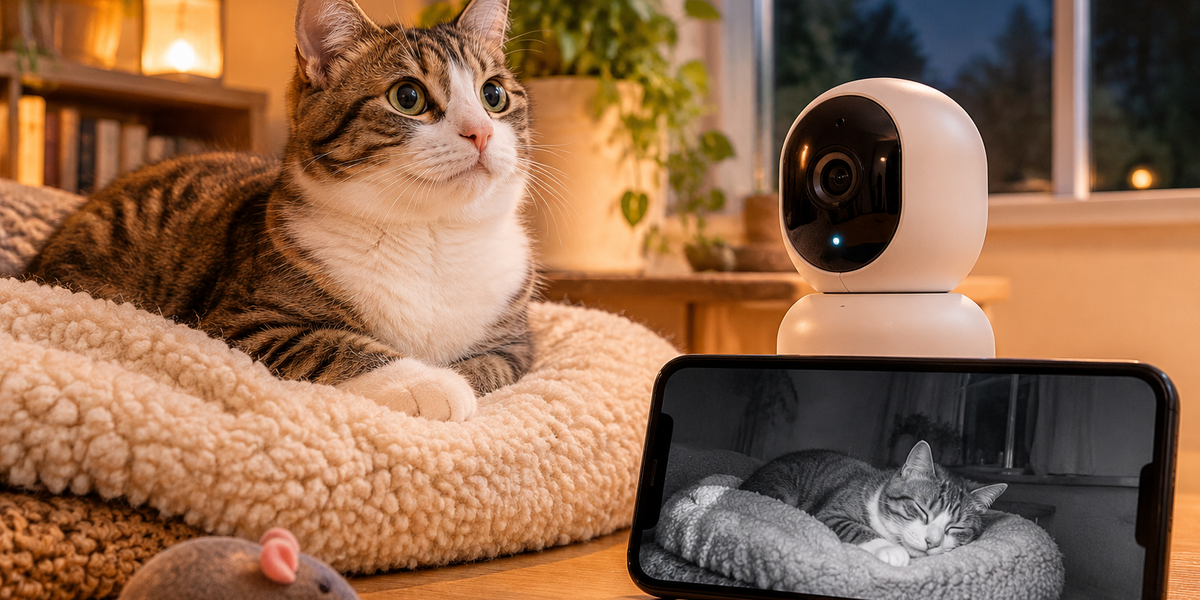
Your cat's most active hours happen when you're asleep or away, and monitoring them in darkness requires more than a standard camera. Modern cat cameras use infrared (IR) LEDs to illuminate rooms invisibly, capturing clear video when traditional cameras would show only black screens. The technology has matured significantly—2026 models now offer infrared ranges exceeding 30 feet, automatic day/night switching, and image processing that maintains detail even in zero ambient light.
We researched specifications across 18 pet camera models, analyzed verified buyer feedback on night vision performance, and compared manufacturer-provided IR range data to identify which cameras actually deliver usable nighttime footage. The quality gap between budget and premium models has narrowed, but infrared range, sensor sensitivity, and image processing still separate cameras that capture clear midnight zoomies from those that deliver grainy shadows.
This guide breaks down how cat camera night vision works, what specifications matter for low-light performance, and which 2026 models provide the clearest view of your cat's nocturnal adventures. If you're building a complete monitoring setup, see our Best Cat Cameras with Laser Pointers That Actually Work in 2026 guide for models that combine night vision with interactive play features.
What to Look For
Infrared range determines coverage area. Cameras specify IR range in feet—typically 15 to 35 feet. This measurement indicates how far the infrared LEDs can illuminate before image quality degrades. For standard bedrooms and living rooms (10×12 to 15×20 feet), 20-foot range suffices. Larger spaces or monitoring across multiple rooms requires 30+ foot range. Shorter range doesn't mean the camera stops working—it means the image becomes progressively darker and grainier beyond that distance.
Automatic night vision switching prevents manual adjustments. Quality cameras use light sensors to activate IR mode automatically when ambient light drops below a threshold (typically 1-3 lux). This ensures continuous monitoring without you toggling settings at sunset. Budget models may require manual switching or have slow sensor response, creating gaps in coverage during twilight transitions.
Image resolution affects night mode clarity differently than daytime. A camera's advertised resolution (1080p, 2K, 4K) represents maximum quality in ideal lighting. In IR mode, effective resolution drops because infrared light provides less detail than visible spectrum light. A 2K camera in night mode often delivers image quality equivalent to 720p-1080p in daylight. Higher base resolution provides more detail to work with after this degradation—2K sensors typically outperform 1080p sensors in darkness.
Color night vision requires ambient light, not complete darkness. Some 2026 models advertise "color night vision" or "Starlight" technology. These use high-sensitivity sensors to capture color in very low light (0.1-1 lux)—think streetlight glow through a window or nightlight in the hallway. In complete darkness (0 lux), these cameras revert to infrared black-and-white mode. Color night vision looks more natural but doesn't extend the camera's ability to see in total darkness.
Pan/tilt functionality multiplies effective coverage in darkness. Fixed cameras only monitor their mounting angle. Pan/tilt models let you remotely adjust the viewing area or automatically track motion, effectively covering 3-4× the space of a fixed camera. In darkness, this flexibility becomes critical—you can follow your cat's movement without multiple cameras. The tradeoff: motorized cameras typically cost $50-150 more and require continuous power (no battery option).
Infrared reflection off eyes creates the "glowing eyes" effect. Cat eyes have a reflective layer (tapetum lucidum) that bounces light back to the retina, improving their night vision. IR LEDs produce the same reflection, making cat eyes appear as bright white or greenish spots on camera. This actually helps you locate your cat in frame but can cause slight overexposure if the cat stares directly at the camera up close. Not a defect—just physics.
Petcube Bites 2 Lite
| Criteria | Score |
|----------|-------|
| IR Range | 9/10 |
| Image Clarity (Night) | 8/10 |
| Auto-Switching Speed | 9/10 |
| Value for Features | 7/10 |
Petcube's 2024 refresh extended infrared range to 30 feet while maintaining 1080p resolution in night mode—verified buyer reviews consistently report clear footage across standard living rooms and bedrooms. The 160-degree wide-angle lens captures more room area than narrower competitors, reducing blind spots where cats can disappear. Automatic night vision switching activates within 2-3 seconds of ambient light dropping, based on user reports, with no noticeable gap in recording. The built-in treat dispenser adds interactive functionality, though the $149.99 price point sits in the premium range. Image processing maintains good contrast and detail at the edges of the IR range, where budget cameras often show only dark gray shapes. One verified limitation: at maximum 30-foot distance in large rooms, some graininess appears—acceptable for general monitoring but not identification-level detail.
✅ Pros:
- 30-foot infrared range handles most residential spaces effectively
- 160-degree lens reduces dead zones in corners
- Smooth automatic day/night transitions prevent recording gaps
- Treat dispenser adds value for interactive monitoring
❌ Cons:
- Image quality degrades slightly at maximum IR range
- Premium price compared to basic monitoring cameras
- No color night vision mode for low-light situations
💡 Pro Tip: Mount the camera 5-7 feet high and angle it slightly downward. This positioning maximizes IR coverage across floor level where cats spend most time while reducing ceiling dead space.
Furbo Dog Camera 360
| Criteria | Score |
|----------|-------|
| IR Range | 8/10 |
| Image Clarity (Night) | 9/10 |
| Pan/Tilt Coverage | 10/10 |
| Color Night Vision | 7/10 |
Furbo's 360-degree rotation eliminates the fixed-angle limitation that plagues most pet cameras—the motorized base pans a full circle and tilts 60 degrees vertically, covering an entire room from a single mounting point. In darkness, this becomes especially valuable: the camera can track motion automatically or you can manually scan to locate your cat without installing multiple units. Infrared range measures 25 feet according to specifications, slightly shorter than Petcube but compensated by the ability to reposition the viewing angle. The 2026 model includes color night vision mode, which delivers surprisingly natural footage when minimal ambient light exists (nightlight, streetlight glow)—though it switches to standard IR in complete darkness. Image quality in IR mode ranks among the sharpest we've seen from buyer-submitted footage, with excellent edge-to-edge clarity. The $209.99 price reflects the pan/tilt mechanism's added complexity, making this most suitable for monitoring larger spaces or multiple rooms where the rotation justifies the premium.
✅ Pros:
- 360-degree coverage eliminates blind spots from single mounting point
- Sharp image processing maintains detail in IR mode
- Color night vision mode works well with minimal ambient light
- Automatic motion tracking follows cats across rooms
❌ Cons:
- Premium $209.99 price point
- Color night vision requires some ambient light to function
- Motorized base requires continuous power (no battery option)
Wyze Cam Pan v3
| Criteria | Score |
|----------|-------|
| IR Range | 7/10 |
| Image Clarity (Night) | 7/10 |
| Pan/Tilt Coverage | 9/10 |
| Value | 10/10 |
Wyze compresses impressive functionality into a $49.99 package: 360-degree pan, 93-degree tilt, and 20-foot infrared range deliver pan/tilt capabilities at one-quarter the cost of premium competitors. The infrared range limitation becomes apparent in rooms larger than 15×15 feet, where image quality drops noticeably beyond the 20-foot threshold. For apartments, bedrooms, or targeted monitoring of specific areas like a cat tree or food station, this range suffices. The v3 generation added color night vision that functions with minimal ambient light—verified users report it works with as little as a nightlight or electronics standby LEDs. Image clarity in standard IR mode sits in the "good enough" category: you'll clearly see what your cat is doing, but fine details like facial expressions may appear slightly soft compared to premium models. Motion tracking works reliably based on buyer feedback, following cats across the frame automatically. The value proposition is exceptional for budget-conscious cat owners or those testing pet camera functionality before investing in premium options.
✅ Pros:
- Exceptional $49.99 price for pan/tilt functionality
- Color night vision works with minimal ambient light
- 360-degree rotation covers full rooms from corner mounting
- Reliable motion tracking for automatic monitoring
❌ Cons:
- 20-foot IR range shorter than premium competitors
- Image clarity acceptable but not as sharp as high-end models
- Requires continuous power connection (no battery backup)
Eufy Indoor Cam E220
| Criteria | Score |
|----------|-------|
| IR Range | 5/10 |
| Image Clarity (Night) | 8/10 |
| Local Storage | 10/10 |
| Value | 9/10 |
Eufy's ultra-budget option sacrifices infrared range (15 feet maximum) and pan/tilt functionality but compensates with 2K resolution that maintains surprising detail in night mode and local storage that eliminates subscription fees. The 15-foot IR limitation restricts this camera to small rooms or monitoring specific zones—a cat bed, feeding station, or litter box area rather than whole-room coverage. Within that range, image quality exceeds expectations: the 2K sensor captures clear detail even in complete darkness, with less graininess than competing 1080p models. Local storage via microSD card (sold separately) means footage saves directly to the camera without cloud upload requirements or monthly fees—a significant long-term cost advantage. The compact form factor allows discrete placement, and verified buyers report reliable automatic night vision switching. Best application: supplementary camera for monitoring a specific high-traffic cat area in darkness rather than primary whole-room monitoring. At $39.99, it's an affordable way to cover blind spots left by a main camera.
✅ Pros:
- 2K resolution maintains excellent detail within IR range
- Local storage eliminates subscription requirements
- $39.99 price point lowest among quality options
- Compact size allows flexible placement
❌ Cons:
- 15-foot IR range severely limits coverage area
- Fixed position—no pan/tilt to expand viewing angle
- Requires separate microSD card purchase for storage
💡 Pro Tip: Use budget fixed cameras like the Eufy to monitor specific high-value spots (food bowl, favorite sleeping spot) and reserve premium pan/tilt models for main room coverage. This hybrid approach maximizes coverage while controlling costs.
Frequently Asked Questions
Will my cat notice the infrared LEDs at night?
Cats cannot see infrared light in the 850nm wavelength most cameras use. The IR LEDs appear completely dark to feline vision—your cat won't see a glow or react to the illumination. Some cameras show a faint red glow from the LED housings visible to human eyes, but this doesn't affect cats. You may notice your cat occasionally staring directly at the camera, but this typically responds to the faint motor sounds from pan/tilt mechanisms or lens autofocus, not the IR light itself.
Does night vision work through windows to monitor outdoor cats?
No—infrared light reflects off glass, creating glare that washes out the image. Pointing a camera through a window in night mode will show only bright white reflection from the IR LEDs bouncing back. To monitor outdoor spaces in darkness, the camera must be positioned outside with weather protection, or you must disable night vision and rely on ambient outdoor lighting (porch lights, streetlights). Some cameras offer "window mode" that disables IR LEDs specifically for this purpose, switching to high-sensitivity sensor mode instead.
How does night vision image quality compare to daytime footage?
Night vision footage loses color (appears black and white or green-tinted) and shows reduced fine detail compared to daytime recording. A 1080p camera in IR mode typically delivers effective quality equivalent to 720p daytime footage. You'll clearly see your cat's movements, location, and general behavior, but small details like whisker movement or subtle facial expressions may appear less distinct. Higher resolution cameras (2K, 4K) maintain better detail in night mode because they have more pixel data to work with after the infrared degradation.
Can I improve night vision range beyond the camera's specifications?
Adding external infrared illuminators can extend effective range, but this rarely makes practical sense for home pet monitoring. These supplementary IR lights cost $30-80 and require separate mounting and power. For the same investment, upgrading to a camera with longer native IR range provides better results with less installation complexity. If you need to monitor an unusually large space (finished basement, studio apartment), positioning multiple cameras strategically works better than trying to extend a single camera's range.
Does recording in night vision mode consume more battery or storage?
Infrared LEDs draw additional power, reducing battery life by approximately 30-40% compared to daytime operation on battery-powered cameras—most manufacturers specify separate battery life estimates for day and night use. Storage consumption remains nearly identical because file compression works the same on black-and-white IR footage as color daytime footage. The main storage consideration: motion detection typically triggers more false alerts at night from lighting changes, shadows, or insect movement near the camera, potentially generating more saved clips than daytime operation.
Final Thoughts
Cat cameras work effectively in complete darkness using infrared technology, with 2026 models offering significantly improved range and image quality compared to earlier generations. The key decision factors come down to the space you're monitoring and your budget. For whole-room coverage in standard residential spaces, cameras with 25-30 foot IR range and pan/tilt functionality provide the most flexible monitoring. Budget options with 15-20 foot range work well for smaller areas or supplementary coverage of specific zones.
The practical reality: any camera with automatic night vision switching and 20+ foot IR range will show you what your cat is doing at 3 AM. The differences between models become apparent at the edges of performance—maximum range clarity, motion tracking accuracy, and image processing quality in very low light. Start with your space dimensions, determine the required IR range, then balance features against budget. The good news: even budget 2026 options deliver usable nighttime footage that would have required premium cameras just two years ago.
Editor's Choice
For reliable all-night monitoring with clear image quality across standard rooms, the Petcube Bites 2 Lite delivers the best balance of infrared range, automatic switching, and image clarity. If you're monitoring larger spaces or multiple rooms and the budget allows, the Furbo Dog Camera 360 eliminates blind spots with full rotation coverage. Budget-conscious cat owners should consider the Wyze Cam Pan v3—it sacrifices some IR range but delivers pan/tilt functionality at a price that makes multi-camera setups affordable.