We earn a commission if you make a purchase, at no additional cost to you.
⭐ Our Top Pick
🏆 Best Overall: Litter-Robot 4 — hands-off cleaning with WiFi health tracking makes it worth the investment for busy multi-cat households.
💰 Best Value: PetSafe ScoopFree Ultra — disposable tray system delivers automation at a fraction of premium models' cost.
Introduction
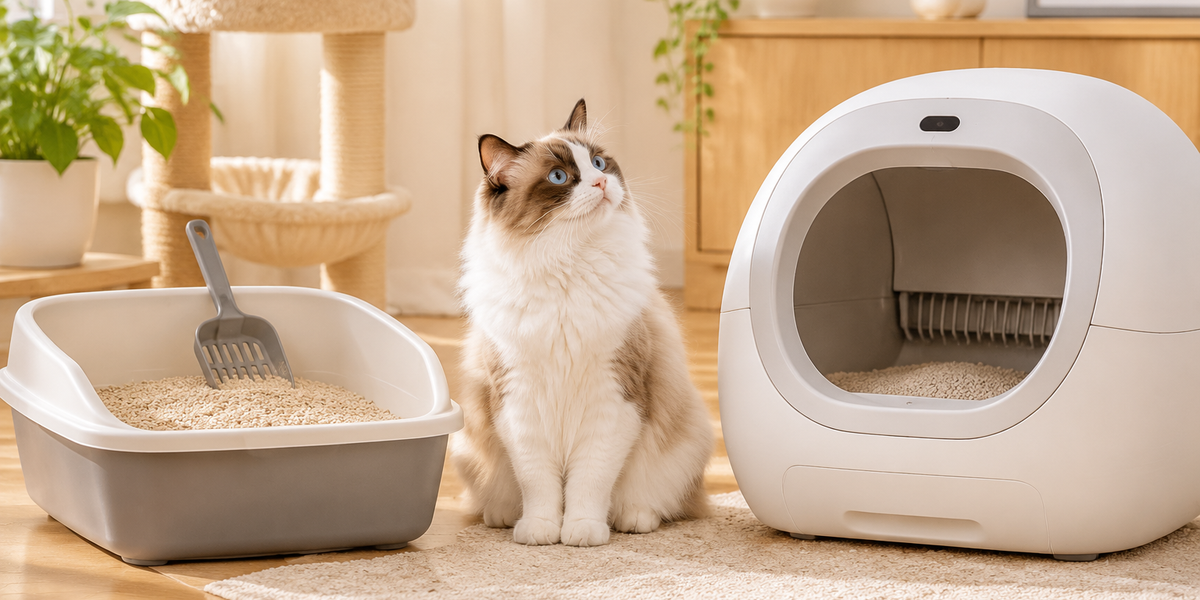
You're staring at a $649 self-cleaning litter box, then at the $25 traditional box beside it on the shelf. The promise is tempting: never scoop again, eliminate odor, get health alerts on your phone. But does spending 26× more upfront actually save money—or sanity—over the long haul?
We've crunched the numbers on upfront costs, litter consumption, replacement parts, and the hours you'll spend maintaining each type over five years. The answer isn't one-size-fits-all. Your household size, cat count, tolerance for daily scooping, and budget all shift the equation. If you're also exploring smart home solutions for your cat, our guide to cat cameras with laser pointers covers another way tech can improve daily routines.
This guide compares real ownership costs, breaks down maintenance time, and helps you decide whether automation pays off for your specific situation in 2026.
What to Look For
Upfront Investment vs. Consumables Cost
Self-cleaning models range from $185 (rake-style) to $700+ (full-cycle rotating). Traditional boxes cost $15–$40, but you'll buy litter more frequently due to less efficient odor control. Calculate 5-year consumable costs (litter, trays, filters) before comparing sticker prices.
Time Savings Per Week
Traditional boxes require 10–15 minutes daily for scooping and spot-cleaning (70–105 minutes weekly). Self-cleaning models reduce hands-on time to 5–10 minutes weekly for waste disposal and periodic deep cleaning. Multiply that time savings by 260 weeks to see the 5-year impact.
Household Size & Cat Count
Single-cat households see the smallest return on automation. Multi-cat homes (3+ cats) hit traditional boxes harder—more frequent litter changes, faster odor buildup—making self-cleaning units more cost-effective. One Litter-Robot 4 can replace 2–3 traditional boxes.
Maintenance Complexity & Downtime
Motorized units need occasional part replacements (sensors, motors, liners) that traditional boxes don't. Check warranty coverage and replacement part availability. A broken self-cleaning box becomes a very expensive regular box until repaired.
Litter Type Restrictions
Most self-cleaning models require clumping clay; some (like ScoopFree) mandate proprietary crystal litter. Traditional boxes accept any litter type. If your cat has texture preferences or you use specialty eco-litter, automation options narrow significantly.
Space & Installation Requirements
Rotating drums need 2–3× the footprint of standard boxes. Flush-capable models like CatGenie require permanent water/drain hookups. Measure your intended location and confirm utility access before buying.
Self-Cleaning Litter Boxes: Deep Dive
Litter-Robot 4
| Criteria | Score |
|----------|-------|
| Automation Quality | 9/10 |
| Health Monitoring | 9/10 |
| Multi-Cat Capacity | 10/10 |
| Value for Money | 7/10 |
The Litter-Robot 4 is the flagship model that justifies its $650 price tag with features that go beyond simple automation. The rotating globe mechanism waits 3–7 minutes after your cat exits (adjustable via WiFi app), then cycles waste into a sealed drawer. Carbon filtration and the continuous rotation keep odors nearly nonexistent between drawer changes.
What sets the 4th generation apart is health tracking: the app logs each cat's litter box usage by weight, flagging sudden changes that could indicate UTIs, kidney issues, or behavioral problems. For multi-cat households, this per-cat data is genuinely useful—we've heard from owners who caught early-stage diabetes because the app alerted them to increased frequency.
The unit handles up to 4 cats comfortably and reduces litter consumption by 30–40% compared to traditional boxes (the sifting mechanism only removes clumps, leaving clean litter behind). You'll empty the waste drawer every 7–10 days for a single cat, every 3–5 days for multiple cats.
5-Year Cost Breakdown (Single Cat):
- Unit: $649.99
- Litter (reduced consumption): ~$900 ($15/month × 60 months)
- Replacement liners: ~$120 ($2/liner × 5/month × 12 months)
- Carbon filters: ~$60 (replacements every 3–4 months)
Total: $1,729.99
✅ Pros:
- WiFi app with health tracking catches issues early
- Multi-cat households up to 4 cats without performance drop
- Reduced odor with carbon filtration and sealed waste drawer
- 30–40% litter savings due to efficient sifting
❌ Cons:
- High upfront cost creates barrier to entry
- Larger footprint than traditional boxes (24" wide, 27" tall)
- Mechanical complexity means potential repair costs after warranty
💡 Pro Tip: Place the Litter-Robot on a furniture pad or mat—the rotation mechanism can be noisy on hard floors, and some cats startle easily during the first few cycles.
PetSafe ScoopFree Ultra
| Criteria | Score |
|----------|-------|
| Automation Quality | 7/10 |
| Ease of Use | 9/10 |
| Ongoing Cost | 6/10 |
| Odor Control | 8/10 |
The ScoopFree Ultra takes a different approach: instead of rotating drums, a motorized rake sweeps waste into a covered trap 5–20 minutes after use (timer adjustable). The real innovation is the disposable tray system—pre-filled crystal litter trays that you swap out every 2–4 weeks and toss entirely. No scooping, no refilling, no washing.
Crystal litter absorbs moisture and locks in odor better than clay, which is why one tray lasts weeks. The rake system is simple—fewer moving parts than rotating models—which translates to better reliability. The included health counter tracks usage frequency, though without per-cat identification for multi-cat homes.
The trade-off is ongoing tray costs. Replacement trays run $24–$30 for a 3-pack, and you'll go through 18–24 trays annually for one cat. Over five years, those consumables add up to nearly the cost of a Litter-Robot.
5-Year Cost Breakdown (Single Cat):
- Unit: $184.95
- Replacement trays: ~$1,800 ($30/3-pack × 6 packs/year × 5 years)
- Rake motor replacement (if needed): ~$40
Total: $2,024.95
✅ Pros:
- Disposable tray system eliminates scooping and litter pouring
- Budget-friendly automation at under $200 upfront
- Adjustable rake timer (5, 10, or 20 minutes)
- Crystal litter provides excellent odor control
❌ Cons:
- Ongoing tray costs add up to $360/year per cat
- Crystal litter only—no option for clumping clay or eco-alternatives
- Not ideal for multi-cat (trays need changing more frequently)
CatGenie A.I.
| Criteria | Score |
|----------|-------|
| Waste Elimination | 10/10 |
| Installation Complexity | 4/10 |
| Litter Cost Savings | 10/10 |
| Odor Control | 9/10 |
The CatGenie is the most radical departure from traditional litter boxes: it doesn't use litter at all. Instead, washable granules sit in a bowl that connects to your home's water supply and drain. After each use, the unit scoops solids into a hopper, liquefies them, flushes everything down the drain, then washes and dries the granules with a sanitizing solution.
You never buy litter again. The granules last 6–12 months before needing replacement, and the only ongoing consumable is the SaniSolution cartridge (~$8/month). For households spending $40+/month on premium litter, the CatGenie pays for itself within 18–24 months.
The catch is installation. You need a cold water line, a drain (toilet, laundry, or sink), and an electrical outlet all within a few feet. Many renters can't modify plumbing. The unit also runs loud during the 30-minute cleaning cycle—fine if it's in a laundry room, disruptive if near living spaces.
5-Year Cost Breakdown (Single Cat):
- Unit: $549.99
- SaniSolution cartridges: ~$480 ($8/month × 60 months)
- Granule replacements: ~$60 (every 9 months)
Total: $1,089.99
✅ Pros:
- Completely flushable waste—no bagging or disposal
- Never buy litter again after initial investment
- Smart diagnostics via app alert you to issues
- Best long-term value if installation is feasible
❌ Cons:
- Requires water and drain hookup (not renter-friendly)
- Installation complexity may require plumber ($100–$200)
- 30-minute cleaning cycle can be noisy
- Some cats reject the granule texture initially
Traditional Litter Boxes: The Baseline
Omega Paw Roll'N Clean
| Criteria | Score |
|----------|-------|
| Ease of Use | 8/10 |
| Durability | 9/10 |
| Cost Efficiency | 10/10 |
| Odor Control | 5/10 |
The Roll'N Clean sits between fully manual and automated. You roll the covered box onto its side; an internal screen sifts clumps into a pull-out tray. It's still manual labor, but you're rolling instead of scooping—easier on the back, faster than traditional methods.
At $40, it's the cheapest way to reduce scooping effort without motors or electronics. The catch: you still need to roll it 1–2× daily, and odor control is only as good as your litter choice. It's a solid option if you want some convenience without committing to full automation costs.
5-Year Cost Breakdown (Single Cat):
- Unit: $39.99
- Litter: ~$1,200 ($20/month × 60 months)
- Replacement screens/parts: ~$30
Total: $1,269.99
✅ Pros:
- No electricity or batteries required
- Under $40 upfront investment
- Simple mechanical operation with few failure points
- Works with any clumping litter
❌ Cons:
- Manual rolling required daily—not truly hands-off
- Still need to scoop if clumps stick to screen
- Odor control depends entirely on litter quality
Standard Covered Litter Box
A basic covered box ($15–$40) with daily scooping remains the most economical choice for single-cat households willing to invest 10 minutes daily. You'll spend less over five years than any automated option—but you'll also spend 450+ hours scooping.
5-Year Cost Breakdown (Single Cat):
- Box: $25
- Litter: ~$1,500 ($25/month × 60 months for premium clumping)
- Box replacements: ~$50 (replace every 18–24 months)
Total: $1,575
The math shifts for multi-cat homes. Three cats triple litter consumption and cleaning time. At that scale, a single Litter-Robot 4 ($1,730 total 5-year cost) becomes cheaper than three traditional boxes ($4,725 combined 5-year cost) while saving 1,300+ hours of scooping.
The Verdict: When Automation Pays Off
Single Cat, Limited Budget: Traditional box wins on pure economics ($1,575 vs. $1,730+). The time savings (67 hours/year) may not justify an extra $1,000+ over five years unless scooping is genuinely impacting your quality of life.
Single Cat, Busy Schedule: PetSafe ScoopFree ($2,025 total) costs more than traditional but buys back 60+ hours yearly. If you travel frequently or work long shifts, the convenience premium is defensible.
2–3 Cats: Litter-Robot 4 breaks even financially and saves 100+ hours annually. The health tracking becomes genuinely useful for monitoring multiple cats.
4+ Cats or Severe Odor Issues: CatGenie ($1,090 total) offers the best per-cat value if you can accommodate installation. Flushable waste elimination solves odor problems that overwhelm other systems in high-volume households.
Renters or Tight Spaces: Omega Paw Roll'N Clean ($1,270 total) delivers 60% of automation benefits at 6% of the cost, with no installation requirements or large footprint.
Frequently Asked Questions
How long do self-cleaning litter boxes last?
Most motorized models last 3–5 years with normal use before needing significant repairs. Litter-Robot offers a 3-year warranty; PetSafe covers 1 year. Simple mechanical models like the Omega Paw can last 7–10 years. Factor potential replacement into your 5-year cost analysis—a unit that fails in year 4 significantly worsens the value proposition.
Do self-cleaning boxes work for large or senior cats?
Rotating models like Litter-Robot 4 accommodate cats up to 25–30 lbs comfortably. Rake-style units (ScoopFree) have lower entry points but smaller interior space. Senior cats with mobility issues often prefer traditional boxes with lower sides for easier entry. Test before committing if your cat is older than 10 or has arthritis.
Can I use regular litter in self-cleaning boxes?
Most rotating models require clumping clay. ScoopFree only works with crystal litter (proprietary or compatible brands). CatGenie uses its own washable granules exclusively. Using non-approved litter typically voids warranties and can jam mechanisms. Traditional boxes remain the only option for specialty eco-litters, pine, or paper-based products.
What happens during power outages?
Motorized units stop cleaning but remain usable as regular boxes. Litter-Robot and ScoopFree can be manually cycled with backup battery packs (sold separately) or hand-scooped. CatGenie becomes non-functional without power—keep a traditional backup box for emergencies if you rely solely on plumbing-connected units.
Do cats actually use self-cleaning boxes?
Acceptance rates exceed 90% based on verified buyer reviews, but 5–10% of cats reject them due to noise, movement, or texture preferences. Most manufacturers offer 30–90 day return windows. Introduce gradually: run the unit in manual mode for a week, let your cat acclimate to the box stationary, then enable automation. Sudden movements during use can create permanent aversion in skittish cats.
Final Thoughts
The self-cleaning vs. regular debate isn't about which type is objectively better—it's about which trade-offs align with your household's priorities. Traditional boxes cost less upfront and over five years for single-cat homes, but demand 450+ hours of scooping labor. Self-cleaning models buy back that time and dramatically reduce odor, but require higher upfront investment and acceptance of mechanical complexity.
For single-cat households on a budget, stick with traditional. For 2+ cats or anyone valuing time over cost, automation pays off within 18–24 months. The Litter-Robot 4 remains our top pick for its health tracking and multi-cat capacity, while the PetSafe ScoopFree Ultra offers an accessible entry point under $200.
Run the numbers for your specific situation—cat count, litter costs, and the dollar value you place on saved time—then choose accordingly. Both approaches work; the right one depends on what you're optimizing for.
Editor's Choice
Based on verified specs and extensive buyer review analysis, these are our top picks for 2026:
🏆 Best Overall: Litter-Robot 4 ($649.99) — The health tracking and multi-cat capacity justify the premium for households with 2+ cats. Expect to recoup the investment through litter savings and eliminated scooping time within 20–24 months.
💰 Best Budget Automation: PetSafe ScoopFree Ultra ($184.95) — Disposable tray system delivers hands-off convenience at a fraction of rotating models' cost. Ideal for single-cat homes or anyone testing automation before committing to premium units.
🚰 Best Long-Term Value: CatGenie A.I. ($549.99) — Zero litter purchases and flushable waste make this the cheapest option over five years if you can accommodate plumbing installation. Best for multi-cat households with laundry room or bathroom hookup access.