We earn a commission if you make a purchase, at no additional cost to you.
⭐ Our Top Pick
🏆 Best Overall: Nature's Miracle Hard Floor Cleaner — enzyme formula safely breaks down urine, vomit, and feces while eliminating odors at the molecular level.
💰 Best Value: Simple Solution Extreme Stain and Odor Remover — affordable pro-bacteria formula that works well for routine carrier cleaning after non-illness vet visits.
Introduction
Your cat's carrier just survived another vet visit—and now it's covered in stress-induced accidents, fur, and potentially contagious pathogens from the waiting room. Whether your cat vomited, urinated, or simply shed everywhere, proper disinfection isn't just about eliminating odors. It's about protecting your cat from upper respiratory infections, parvovirus, and other illnesses that can survive on surfaces for days or even weeks.
We researched veterinary disinfection protocols, compared manufacturer specs for leading pet-safe cleaners, and compiled verified buyer reviews to bring you a practical, step-by-step guide to carrier cleaning. This isn't about perfection—it's about creating a clean, safe space your cat can use for the next trip without health risks or lingering smells that make them resist entering.
In this guide, we'll walk you through the complete disinfection process, recommend the best cleaning products based on your specific needs, and answer the most common questions cat owners ask after a messy vet visit.
What to Look For
When choosing cleaning products and methods for your cat carrier, prioritize these key factors:
Pet-Safe Ingredients — Avoid bleach, ammonia, phenols, and essential oils, all of which are toxic to cats. Look for enzyme cleaners or veterinary-approved disinfectants that are safe once dried.
Pathogen Coverage — Routine enzyme cleaners work for accidents and odors. If your cat was exposed to sick animals at the clinic, choose a disinfectant rated against feline panleukopenia, calicivirus, and upper respiratory pathogens.
Material Compatibility — Hard plastic carriers tolerate stronger disinfectants; soft-sided carriers with fabric panels require gentler, fabric-safe formulas. Check that your cleaner won't degrade zippers, mesh, or plastic welds.
Contact Time — Disinfectants need to stay wet on the surface for a specified period (usually 5-10 minutes) to kill pathogens. Enzyme cleaners may require longer dwell times to fully break down organic matter.
Odor Elimination, Not Masking — Cats have 200 million scent receptors. Strong artificial fragrances can make them refuse the carrier. Choose cleaners that neutralize odors at the molecular level rather than covering them with perfume.
Ease of Rinsing — Many disinfectants require thorough rinsing before your cat re-enters the carrier. Consider whether you have access to a hose, bathtub, or large sink.
Step-by-Step Carrier Disinfection Process
Before diving into product reviews, here's the complete cleaning workflow we recommend based on veterinary best practices:
Step 1: Remove Your Cat and All Bedding — Take out any blankets, pee pads, or toys. Wash fabric items separately in hot water with pet-safe detergent.
Step 2: Disassemble the Carrier — If your carrier has a removable bottom tray, wire door, or separable top and bottom halves, take it apart. This exposes hidden crevices where urine and feces collect.
Step 3: Remove Solid Waste and Debris — Use paper towels to remove visible feces, vomit, or clumps of fur. Dispose of waste in a sealed bag.
Step 4: Pre-Rinse (Outdoor or Tub) — Rinse the carrier with lukewarm water to remove loose dirt, hair, and urine. A handheld showerhead or garden hose works best.
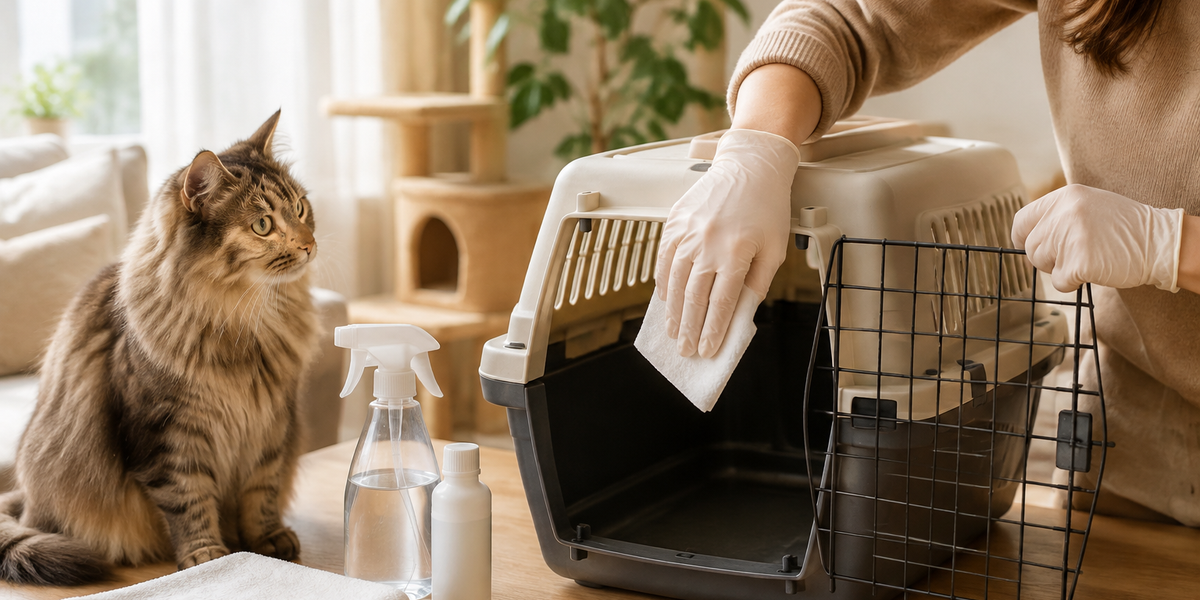
Step 5: Apply Enzyme Cleaner or Disinfectant — Spray or wipe the entire interior and exterior, paying special attention to corners, seams, and ventilation slots. Let the product sit for the full recommended contact time (usually 5-10 minutes).
Step 6: Scrub and Agitate — Use a soft-bristle brush or sponge to work the cleaner into textured surfaces and crevices. For fabric carriers, gently scrub mesh panels and zippers.
Step 7: Rinse Thoroughly — Rinse with clean water until no soap residue remains. Residual chemicals can irritate your cat's paws and respiratory system.
Step 8: Air Dry Completely — Place the carrier in a sunny, well-ventilated area. UV light from the sun provides additional disinfection. Avoid reassembling until fully dry—damp environments breed bacteria.
💡 Pro Tip: If your cat had diarrhea or was diagnosed with a contagious illness, disinfect the carrier twice—once with an enzyme cleaner to remove organic matter, then again with a veterinary-grade disinfectant to kill pathogens.
Best Cleaning Products for Cat Carriers
Nature's Miracle Hard Floor Cleaner
| Criteria | Score |
|----------|-------|
| Odor Elimination | 9/10 |
| Safety for Cats | 10/10 |
| Ease of Use | 8/10 |
| Value | 9/10 |
Nature's Miracle uses bio-enzymatic technology to break down the proteins in urine, vomit, and feces at the molecular level. Unlike disinfectants that simply kill surface bacteria, enzymes continue working as long as moisture is present, making this formula particularly effective for porous surfaces and hard-to-reach crevices. The product is safe for cats once dried and works on hard plastic, metal hardware, and even fabric trim. Based on verified buyer reviews, most cat owners report complete odor elimination after one application, though heavily soiled carriers may need a second treatment.
✅ Pros:
- Enzyme formula breaks down organic stains and odors
- Safe for pet use when dried
- Works on plastic, metal, and fabric
❌ Cons:
- Requires 10-minute contact time
- Strong initial scent
Rescue Disinfectant Wipes
| Criteria | Score |
|----------|-------|
| Pathogen Kill Rate | 10/10 |
| Convenience | 9/10 |
| Safety for Cats | 8/10 |
| Value | 6/10 |
Rescue is the same accelerated hydrogen peroxide disinfectant used in veterinary hospitals and animal shelters. It's EPA-registered to kill parvovirus, feline panleukopenia, calicivirus, and upper respiratory pathogens—the exact diseases your cat might encounter in a vet clinic waiting room. The pre-moistened wipes make it easy to thoroughly coat all surfaces without overspray. The one-minute contact time is significantly faster than most disinfectants. However, Rescue requires rinsing before your cat re-enters the carrier, and the cost per cleaning is higher than spray formulas.
✅ Pros:
- Veterinary-grade disinfection
- Kills parvovirus, panleukopenia, and upper respiratory viruses
- Pre-moistened for convenience
❌ Cons:
- More expensive than spray cleaners
- Requires rinsing after use
Simple Solution Extreme Stain and Odor Remover
| Criteria | Score |
|----------|-------|
| Odor Elimination | 7/10 |
| Safety for Cats | 10/10 |
| Ease of Use | 9/10 |
| Value | 10/10 |
For routine carrier cleaning when your cat isn't sick and wasn't exposed to contagious animals, Simple Solution offers excellent value. The pro-bacteria and enzyme formula breaks down organic waste and continues working for up to 80 hours after application. The 32-ounce bottle is nearly double the size of competing products at a similar price point. While it's not formulated to kill veterinary pathogens like panleukopenia, it's more than adequate for cleaning up stress-induced accidents from a healthy cat's routine vet visit.
✅ Pros:
- Budget-friendly option
- Pro-bacteria formula continues working after application
- Large 32 oz bottle
❌ Cons:
- Not formulated for veterinary pathogens
- Takes longer to eliminate odors
Neater Pet Brands Cat Carrier with Top Load
| Criteria | Score |
|----------|-------|
| Cleanability | 10/10 |
| Durability | 8/10 |
| Cat Comfort | 7/10 |
| Value | 8/10 |
While not a cleaning product itself, investing in a carrier designed for easy disinfection can save you hours of scrubbing. The Neater Pet Brands carrier features a fully removable bottom tray that slides out for quick rinsing, and the top-loading design means you're not contorting your arm into a narrow side door to reach the back corners. The smooth, hard plastic interior has minimal seams and crevices where waste can hide. Buyer reviews consistently mention how much faster this carrier is to clean compared to traditional models.
✅ Pros:
- Top-loading design makes cleaning easier
- Fully removable bottom tray
- Smooth plastic with minimal crevices
❌ Cons:
- Larger footprint than side-entry carriers
- Wire door can trap debris
When to Use Heavy-Duty Disinfection
Not every vet visit requires veterinary-grade disinfection. Here's how to match your cleaning protocol to the situation:
Use Enzyme Cleaners (Nature's Miracle, Simple Solution) For:
- Routine wellness exams where your cat was healthy
- Stress-induced urination or defecation during transport
- Regular odor control and maintenance cleaning
- Carriers that only contacted your own cat
Use Veterinary Disinfectants (Rescue, Virkon) For:
- Visits to emergency clinics with sick animal populations
- Any time your cat was diagnosed with a contagious illness
- After your carrier touched waiting room floors or shared surfaces
- When adopting a new cat who traveled in the carrier
- Boarding facility drop-offs where disease exposure is higher
💡 Pro Tip: Keep both an enzyme cleaner and a small container of disinfectant wipes in your pet supply kit. Use the enzyme cleaner for routine cleaning and save the disinfectant for high-risk situations.
Cleaning Soft-Sided Carriers
Fabric carriers require a gentler approach than hard plastic models:
Immediate Spot Treatment — Blot (don't rub) any wet accidents with paper towels. Apply enzyme cleaner directly to the stain and let it sit for 10 minutes.
Machine Washing — Many soft-sided carriers have removable fabric covers that are machine washable. Check the manufacturer's tag and wash on gentle cycle with pet-safe detergent. Air dry completely—heat can set stains and odors.
Frame and Structure Cleaning — Wipe down the internal frame, zippers, and plastic reinforcements with disinfectant wipes or a spray cleaner on a cloth. Avoid soaking fabric-covered foam padding.
Dealing with Persistent Odors — If odors remain after washing, soak the fabric components in a solution of enzyme cleaner and water (follow product dilution instructions) for 30 minutes before machine washing again.
When to Replace — Fabric carriers have a shorter lifespan than hard-sided models when it comes to disinfection. If your cat had a serious illness and the carrier has deep fabric padding that can't be fully submerged or machine washed, consider replacing it rather than risking incomplete disinfection.
Frequently Asked Questions
Can I use bleach to disinfect my cat carrier?
Bleach is highly effective at killing pathogens, but it's risky for cat carriers. Even after thorough rinsing, bleach residue can irritate your cat's respiratory system and paw pads. Bleach also degrades plastic over time, causing carriers to become brittle and crack. If you do use a diluted bleach solution (1:32 ratio for disinfection), you must rinse extensively and air dry for at least 24 hours. We recommend veterinary-approved disinfectants like Rescue instead—they're formulated to be safer while offering equal or better pathogen kill rates.
How long should I wait before putting my cat back in a cleaned carrier?
The carrier must be completely dry before reuse. Damp environments allow bacteria and mold to grow, and residual moisture can hold cleaning product residue that irritates your cat. After rinsing, air dry the carrier in direct sunlight for 4-6 hours, or indoors with good airflow for 8-12 hours. If you used a disinfectant that requires rinsing, an extra 24-hour drying period is safest. Your cat should not smell any cleaning product when you place them inside.
My cat urinated in the carrier—will the smell ever come out?
Cat urine contains uric acid crystals that bond to surfaces and reactivate with humidity, which is why traditional cleaners often fail. Enzyme cleaners are specifically designed to break down these crystals at the molecular level. For best results, clean the carrier as soon as possible—dried urine is harder to eliminate. Apply the enzyme cleaner generously, let it sit for the full contact time, and don't rinse it away too quickly. For severe cases, apply the enzyme cleaner, let it dry completely without rinsing, then apply a second treatment before the final rinse.
Do I need to clean the carrier after every vet visit?
Yes, even if your cat didn't have an accident. Carriers pick up pathogens from waiting room floors, exam tables, and contact with other pet carriers. At minimum, wipe down the exterior and interior with a disinfectant wipe after each visit. Do a full disassembly and deep clean if your cat had an accident, if you noticed sick animals in the waiting room, or every 3-4 vet visits as preventive maintenance.
Can I put a plastic cat carrier in the dishwasher?
While some cat owners do this, we don't recommend it. Dishwasher heat can warp plastic and weaken structural joints, especially on carriers with metal hardware or multiple assembled pieces. The high heat may also bake in organic stains rather than removing them. The manual cleaning process we outlined is more effective and won't risk damaging your carrier. If you want a truly hands-off approach, look for carriers with removable bottom trays that can be individually washed in a sink.
Final Thoughts
Cleaning your cat carrier after a vet visit is one of those tasks that's easy to procrastinate—but doing it promptly protects your cat's health and makes the next trip less stressful for both of you. A carrier that smells like fear, urine, or illness will make your cat resistant to entering it, turning every future vet visit into a struggle.
By following the step-by-step disinfection process and choosing the right cleaning product for your situation, you can eliminate odors, kill pathogens, and reset the carrier to a neutral state. For routine cleaning, an enzyme cleaner like Nature's Miracle offers the best combination of effectiveness, safety, and value. When your cat has been exposed to contagious illnesses, step up to veterinary-grade disinfectants like Rescue.
The 20 minutes you invest in proper carrier cleaning today will pay dividends in easier vet visits, better cat health, and a carrier that lasts for years instead of becoming a permanent source of stress and odors.
Editor's Choice
Based on verified specs and buyer reviews, we recommend Nature's Miracle Hard Floor Cleaner for routine carrier cleaning—it's safe, effective, and affordable for regular use. If your cat was exposed to contagious illness, add Rescue Disinfectant Wipes to your cleaning protocol for veterinary-grade pathogen protection. And if you're in the market for a new carrier, the Neater Pet Brands Cat Carrier will make every future cleaning session faster and more thorough.