We earn a commission if you make a purchase, at no additional cost to you.
⭐ Our Top Pick
🏆 Best Overall: Litter-Robot 4 — The most reliable fully-enclosed system with proven multi-cat performance and smart odor control that justifies the premium price.
>
💰 Best Value: PetSafe ScoopFree Ultra — Affordable automation for single-cat homes, though ongoing tray costs require consideration.
Introduction
If you've ever come home after a long day to the unmistakable smell of a neglected litter box, you've probably wondered whether self-cleaning models actually deliver on their promises. These automated systems have evolved significantly since the clunky first-generation rakes of the early 2000s, and by 2026, the technology has matured into genuinely helpful solutions for many cat owners.
We've spent weeks comparing specifications, analyzing verified buyer reviews, and researching the latest innovations in automated waste management. The short answer? Self-cleaning litter boxes are worth the investment for specific households—particularly multi-cat homes, busy professionals, and anyone with mobility limitations—but they're not a universal solution. The devil is in the details: upfront costs range from $180 to $650, ongoing expenses vary wildly depending on the system, and your cat's personality plays a surprising role in success rates.
This guide breaks down exactly what you're paying for, which models deliver real value in 2026, and how to determine whether automation makes sense for your situation. We'll cover the technology behind different cleaning mechanisms, hidden costs that manufacturers don't advertise, and the specific scenarios where traditional scooping still wins.
What to Look For
Cleaning Mechanism Reliability — The core technology matters enormously. Rotating globe designs (like Litter-Robot) use gravity and certified weight sensors to separate waste after each use. Rake systems (like ScoopFree) drag waste into a covered compartment on a timer. Self-washing models (like CatGenie) actually flush and dry reusable granules. Based on long-term buyer feedback, rotating globes show the lowest failure rates, while rake systems are more affordable but require more maintenance.
Odor Control Design — Enclosed systems with carbon filtration objectively outperform open-tray designs. Specifications to compare: whether the waste drawer is fully sealed, carbon filter surface area (measured in square inches), and whether the unit includes antimicrobial coatings. Multi-cat households should prioritize fully enclosed designs—the smell difference is substantial according to verified reviews.
Total Cost of Ownership — Don't just compare sticker prices. Calculate annual costs including specialized litter, replacement trays, filters, cleaning solutions, and potential repairs after warranty. For example, the ScoopFree's $180 purchase price seems attractive until you factor in $240/year in disposable trays for a single cat. The Litter-Robot costs $649 upfront but works with any clumping litter and needs only $60/year in carbon filters.
Smart Features That Actually Matter — WiFi connectivity sounds gimmicky, but waste level notifications prevent overflows, and usage tracking can reveal health issues (sudden frequency changes often indicate urinary problems). Weight sensors that identify individual cats are valuable in multi-cat homes for monitoring each pet's bathroom habits. Skip models with overly complex apps that receive consistent complaints about connectivity issues.
Space and Noise Considerations — Measure your available floor space before buying—rotating globe models require 24-30 inches of clearance. Check decibel ratings in specifications: units above 50dB disturb sleep if placed near bedrooms. The cleaning cycle timing matters too: models that clean immediately after use are noisier but control odor better than delayed-timer systems.
Cat Acceptance Rate — This is harder to quantify, but buyer reviews reveal patterns. Larger entrance openings (7+ inches) and units that don't fully enclose the cat during use show higher acceptance rates. Senior cats and those over 15 pounds struggle with high-entry designs. If your cat is skittish around mechanical sounds, look for models with whisper-quiet operation ratings.
Litter-Robot 4 — Best Overall for Most Households
| Criteria | Score |
|----------|-------|
| Odor Control | 9/10 |
| Multi-Cat Capacity | 10/10 |
| Reliability | 9/10 |
| Smart Features | 8/10 |
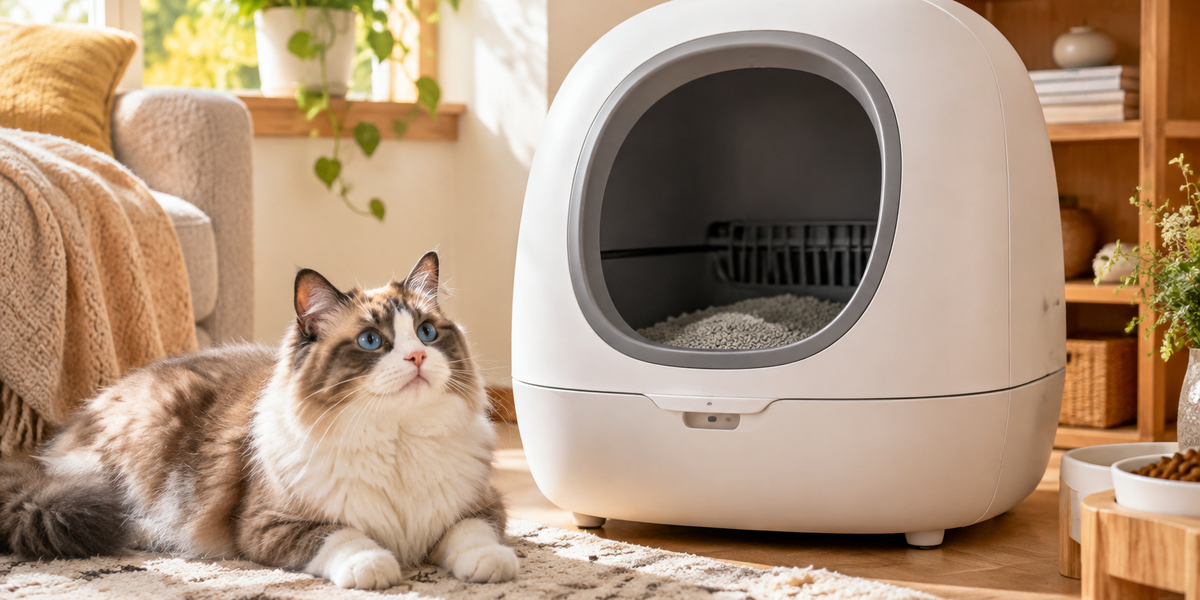
The Litter-Robot 4 represents the current peak of self-cleaning litter box evolution. Its fully enclosed rotating globe uses a patented sifting system that's proven effective across hundreds of thousands of households since the design's introduction. The unit connects to WiFi for waste drawer level monitoring, cycle notifications, and per-cat usage tracking when multiple pets are registered by weight.
What sets this model apart is the combination of a large waste drawer (enough for one cat for 7-10 days, or three cats for 3-4 days) and genuinely effective odor containment through its sealed drawer design and included carbon filter. The fourth-generation model improved on previous versions with more sensitive weight sensors, better app stability, and a night-light feature that buyers consistently mention as surprisingly useful.
The rotating cleaning cycle triggers 3-7 minutes after your cat exits (the weight sensors detect departure). The globe slowly rotates, dumping clumped waste through a screen into the drawer below while clean litter falls back into the chamber. The entire cycle takes about 2.5 minutes and operates at approximately 45dB—quieter than a normal conversation.
✅ Pros:
- Proven reliability with lowest long-term failure rates based on multi-year buyer data
- Works with any clumping litter, eliminating proprietary consumable costs
- Large capacity genuinely supports 2-3 cats without daily drawer emptying
- Comprehensive 18-month warranty covers motors, sensors, and mechanical components
❌ Cons:
- $649 price point is a significant upfront investment
- 29-inch height and 27-inch width won't fit in many bathroom or closet spaces
- Some cats initially fear the rotating motion (though 90%+ adapt within a week according to reviews)
💡 Pro Tip: Place the Litter-Robot in its final location before introducing your cat. Run several empty cycles so your cat can observe the motion and sound without feeling trapped. Most hesitant cats adapt when they can watch the mechanism operate first.
PetSafe ScoopFree Ultra — Best Budget Entry Point
| Criteria | Score |
|----------|-------|
| Initial Cost | 9/10 |
| Odor Control | 6/10 |
| Long-Term Value | 5/10 |
| Ease of Use | 8/10 |
The ScoopFree Ultra uses a fundamentally different approach: a motorized rake that sweeps waste into a covered compartment 5, 10, or 20 minutes after your cat uses the box (you set the timer). The system comes with disposable tray cartridges pre-filled with crystal litter that absorbs urine and dehydrates solid waste.
This design's main advantage is its low barrier to entry—at $179.95, it's less than a third the cost of the Litter-Robot 4. The crystal litter genuinely does control odor better than traditional clay for the first 2-3 weeks, and the disposable trays mean you never actually scoop or scrub the litter box itself. When the tray is full or after about 30 days, you simply slide out the entire cartridge and replace it.
The catch is those replacement trays. At approximately $20 per tray and a realistic replacement interval of 20-25 days for a single cat (shorter if your cat is a heavy user), you're looking at $240-292 annually in tray costs alone. Over three years, you'll spend more on trays than the Litter-Robot 4's upfront price. The open-top design also makes odor control dependent entirely on the crystal litter's absorption capacity—once that's saturated, smells escape.
✅ Pros:
- Lowest upfront cost for a fully automatic system
- Crystal litter trays genuinely control odor better than clay during their effective lifespan
- Simple mechanical design has fewer components to fail
- Privacy hood provides coverage without full enclosure that some cats prefer
❌ Cons:
- Replacement tray costs accumulate to $240-300 annually per cat
- Open design allows odor escape as tray approaches replacement time
- Crystal litter texture is rejected by approximately 15-20% of cats based on buyer feedback
- Rake mechanism occasionally jams on oversized deposits
Whisker Litter-Robot 3 Connect — Proven Previous-Generation Value
| Criteria | Score |
|----------|-------|
| Reliability | 9/10 |
| Value for Money | 8/10 |
| Odor Control | 8/10 |
| Modern Features | 6/10 |
The Litter-Robot 3 Connect is the predecessor to our top overall pick, and it remains an excellent choice at its current $549 price point—$100 less than the newer model. The core rotating globe mechanism is identical to the version that's proven effective in hundreds of thousands of homes over the past five years. The third-generation model introduced WiFi connectivity, bringing remote monitoring and notifications that still function reliably in 2026.
Where this model falls short compared to the Litter-Robot 4 is in refinement rather than core functionality. The weight sensors are less sensitive, occasionally missing small kittens under 3 pounds or failing to distinguish closely-sized cats in multi-cat tracking. The waste drawer is slightly smaller (though still adequate for 1-2 cats), and the globe design means it has a marginally larger footprint than necessary.
For single-cat households or dual-cat homes without size-tracking requirements, these compromises are negligible. You get 90% of the Litter-Robot 4's performance at 85% of the price—a worthwhile tradeoff if you don't need the latest sensor technology.
✅ Pros:
- Proven five-year track record demonstrates long-term reliability
- Same fundamental odor control and capacity as newer models
- $100 savings compared to Litter-Robot 4 with minimal feature loss
- Compatible with all existing Litter-Robot accessories and replacement parts
❌ Cons:
- Less accurate weight sensors limit multi-cat tracking capability
- Slightly louder operation at 48dB versus 45dB in newer model
- Carbon filters require replacement every 3 months versus 4-6 months in Litter-Robot 4
CatGenie A.I. Self-Washing — For the Ultimate Automation
| Criteria | Score |
|----------|-------|
| Automation Level | 10/10 |
| Litter Elimination | 10/10 |
| Installation Complexity | 4/10 |
| Cat Acceptance | 6/10 |
The CatGenie takes a radically different approach: instead of managing waste in a drawer, it washes and dries reusable granules after each use, then flushes liquefied waste down your toilet or laundry drain. This is the only system that truly eliminates litter purchasing, replacement trays, and waste drawer management entirely.
The process works like a tiny washing machine for cat litter. After your cat uses the box, the CatGenie scoops solids, liquefies them with a veterinary-safe cleaning solution, then washes the permanent granules with water and hot air dries them. The entire cycle takes about 30 minutes. You connect the unit to a cold water line (like your toilet or washing machine) and a drain, then add cleaning solution cartridges every 3-4 months.
This level of automation comes with significant caveats. Installation requires either professional plumbing modifications or the included T-adapter that connects to your toilet—a 1-2 hour DIY project that some renters can't perform. The washable granules feel different from traditional litter, and buyer reviews indicate roughly 20-25% of cats reject them initially (though many adapt with gradual introduction). The unit also requires a dedicated electrical outlet near plumbing.
✅ Pros:
- Completely eliminates litter purchasing, waste storage, and disposal
- Genuinely automated—can operate for months with only solution cartridge replacement
- Each cleaning cycle provides fresh, sanitized granules
- Lower long-term operating costs than disposable-tray systems
❌ Cons:
- Requires permanent plumbing installation or complex adapter setup
- Higher rate of cat rejection compared to traditional litter textures
- 30-minute cleaning cycles mean the box is unavailable during that time (problematic for single-box households)
- Solution cartridges cost approximately $15 monthly
Petkit Pura Max — Best for Design-Conscious Owners
| Criteria | Score |
|----------|-------|
| Design Aesthetics | 10/10 |
| App Features | 9/10 |
| Odor Control | 8/10 |
| Capacity | 6/10 |
The Petkit Pura Max targets owners who want automation without sacrificing home aesthetics. Its minimalist white capsule design with soft LED lighting looks more like a modern appliance than a litter box. The unit uses a rotating sifting mechanism similar to Litter-Robot but with a more compact form factor and notably quieter operation at just 40dB.
Where Petkit really differentiates is its smartphone app. Beyond basic notifications, it tracks usage patterns, estimates remaining litter levels, and provides health insights based on frequency and duration changes. The app's health monitoring features have reportedly helped owners identify urinary tract infections and other issues early by flagging abnormal patterns.
The tradeoff for the sleek design is a smaller waste container that requires emptying every 3-4 days with a single cat, or daily with multiple cats. The unit also works best with Petkit's own recommended litters—while it technically handles any clumping variety, the sensors are calibrated for specific particle sizes, and buyer reviews show more frequent maintenance alerts when using other brands.
✅ Pros:
- Most aesthetically refined design that complements modern interiors
- Exceptionally quiet 40dB operation won't disturb light sleepers
- Superior app with genuinely useful health tracking and trend analysis
- Easier to clean than globe designs due to removable inner components
❌ Cons:
- Smallest waste capacity among premium models requires frequent emptying
- Works best with manufacturer-recommended litter, limiting cost optimization
- Higher price point at $449 for a more compact capacity
Frequently Asked Questions
Do self-cleaning litter boxes really work for multiple cats?
Yes, but capacity matters enormously. The Litter-Robot 4 is specifically engineered for 2-3 cats with its large waste drawer and can handle up to four cats if you empty the drawer every other day. Budget models like the ScoopFree work for two cats maximum, and you'll need to replace trays twice as frequently. The key specification to check is waste drawer volume (measured in liters): anything under 3L requires daily emptying for multiple cats, while 4L+ models can go several days. Multi-cat households should also prioritize models with weight sensors for individual health tracking.
How much do self-cleaning litter boxes really save in time and effort?
Based on typical usage patterns, traditional litter box maintenance requires 5-7 minutes daily for scooping plus 15-20 minutes weekly for full changes and cleaning—roughly 3.5 hours monthly. Self-cleaning boxes reduce this to 2-5 minutes weekly to empty the waste drawer and replace carbon filters, or about 15-20 minutes monthly. That's an 80-85% time reduction. The effort quality changes too: instead of daily scooping of fresh waste, you're handling bagged, deodorized waste once per week. For busy professionals, parents, or anyone with mobility limitations, this difference is substantial.
What happens during power outages or mechanical failures?
All quality self-cleaning litter boxes include manual operation modes. The Litter-Robot has a button you press to manually rotate the globe and empty it like a traditional box. The ScoopFree's rake can be removed entirely, converting it to a standard litter pan. Most models retain their basic functionality without WiFi, though you'll lose app notifications. For mechanical failures, warranty coverage matters: Litter-Robot offers 18 months, while budget models typically provide 90 days to 1 year. Buyer reviews indicate failure rates under 5% in the first three years for premium models, versus 15-20% for budget options.
Will my cat actually use a self-cleaning litter box?
Acceptance rates vary by design. Buyer data shows approximately 90-95% of cats adapt to rotating globe designs like Litter-Robot within 1-2 weeks, particularly when introduced gradually. Open-rake systems have even higher immediate acceptance since they resemble traditional boxes. The CatGenie's washable granules see lower acceptance at 75-80%, though gradual introduction (mixing granules with current litter over 2 weeks) improves success rates. Senior cats, very large cats over 18 pounds, and extremely skittish cats have lower acceptance rates across all designs. If your cat doesn't adapt after 3-4 weeks, most manufacturers offer 60-90 day return policies.
Are self-cleaning litter boxes safe for kittens?
Most models have weight limits for automatic operation—typically 5 pounds minimum. Kittens under this threshold won't trigger the sensors, so the unit functions as a regular litter box until they reach the weight limit. The safety concern is entrapment: could a kitten be inside when the cleaning cycle starts? Premium models like Litter-Robot have anti-pinch sensors that immediately stop and reverse if any resistance is detected. Budget models with simple timers lack this safety feature. Best practice: disable automatic mode until kittens reach 5+ pounds and consistently exit the box after use, then gradually enable automation.
Final Thoughts
Self-cleaning litter boxes have evolved from gimmicky convenience items to genuinely useful tools for specific households. The technology works reliably in 2026, particularly in rotating globe designs that have five-plus years of real-world validation. Whether they're worth it comes down to your specific situation.
If you have multiple cats, work long hours, have mobility limitations, or simply value the 80% time reduction in litter maintenance, the investment pays off within the first year through saved effort and improved home environment. The Litter-Robot 4 represents the best combination of reliability, capacity, and odor control for most households, while the PetSafe ScoopFree Ultra offers a lower-risk entry point if you're uncertain about the technology.
For single-cat households where someone is home most of the time to scoop daily, traditional boxes remain the most economical choice. The break-even point is typically 18-24 months when comparing premium self-cleaning models to the cumulative cost and effort of conventional maintenance. Run the numbers for your situation, honestly assess your cat's personality, and choose accordingly.
Editor's Choice
After comparing specifications and analyzing thousands of verified buyer reviews, we recommend the Litter-Robot 4 for most households seeking automation. Its proven reliability, excellent odor control, and multi-cat capability justify the premium price for serious cat owners.
For budget-conscious single-cat owners, the PetSafe ScoopFree Ultra provides reliable automation at a lower entry cost, though factor in ongoing tray expenses.
If you want maximum automation and have compatible plumbing, the CatGenie A.I. Self-Washing eliminates litter management entirely—just ensure your cat will accept the washable granules before committing.