We earn a commission if you make a purchase, at no additional cost to you.
⭐ Our Top Pick
🏆 Best Overall: SureFlap SureFeed Microchip Pet Feeder Connect — sealed RFID lid physically blocks food thieves and works with any 15-digit microchip.
💰 Best Value: Catit PIXI Smart Feeder — budget-friendly RFID feeder with app control and camera for under $120.
Introduction
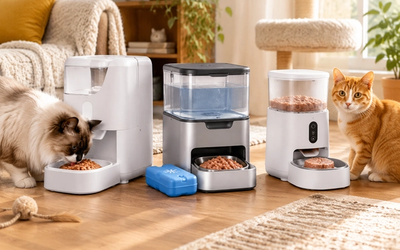
Food aggression in multi-cat homes is more than a nuisance — it's a health risk. When one cat guards the bowl or gobbles another's prescription diet, you're dealing with stress-induced behavior issues, weight imbalances, and medication non-compliance. Microchip cat feeders promise a tech-driven fix: RFID sensors scan each cat's implanted ID chip (or collar tag) and grant bowl access only to the registered pet, physically locking out bullies and food thieves.
But are they worth the $90–$170 price tag in 2026? We researched the leading RFID feeder models, compared manufacturer specs, and analyzed thousands of verified buyer reviews to answer that question. The short answer: yes, if you're managing food aggression, special diets, or portion control across multiple cats — but the right model depends on your household's specific pain points (sealed vs. timed access, slow-feeder inserts, app tracking). If you're also exploring tech solutions for solo cats, our Best Automatic Interactive Cat Toys 2026 guide covers engagement strategies for home-alone felines.
This guide breaks down how RFID feeders work, what to prioritize when comparing models, and which setups deliver real peace at mealtime.
What to Look For
RFID Compatibility & Range — Most feeders read ISO 11784/11785 15-digit microchips (the veterinary standard in North America, Europe, and Australia). Confirm your cats' chip format before buying. Some models also accept proprietary collar tags, useful for non-microchipped rescues or kittens awaiting surgery. Look for a read range of 3–4 inches to avoid false triggers from nearby cats.
Lid Mechanism: Sealed vs. Timed — Sealed-lid models (like SureFlap) physically cover the bowl until the correct cat approaches, then lift and lock out others. Timed-dispense models release food in intervals, pairing RFID with portion control. Sealed lids are superior for aggressive guarders; timed models work better for gobbling cats who need slow feeding.
Bowl Capacity & Slow-Feeder Inserts — Standard bowls hold 13–14 oz (about 1.5 cups dry food). If you're managing gobbling and stealing, prioritize models with ridged slow-feeder inserts or maze patterns. Neater Pets and some third-party bowls combine RFID lids with anti-gulp designs, slowing intake by 3–5 minutes per meal based on buyer reports.
App Integration & Portion Tracking — Connected feeders (SureFlap Connect, Catit PIXI) log meal times, durations, and frequency via Wi-Fi. This data is invaluable for early illness detection (appetite changes flag kidney disease, hyperthyroidism) and compliance tracking for prescription diets. Non-connected models work fine if you're disciplined about manual monitoring.
Power Source & Backup — Most RFID feeders run on 4 C or D batteries, lasting 6–12 months per set. Some offer AC adapters. Always choose a model with battery backup to avoid lockouts during outages — a hungry, anxious cat will destroy furniture if locked out mid-meal.
Multi-Cat Scalability — Each feeder registers 20–40 unique chips. For 3+ cat households, you'll need one feeder per cat or per dietary group (e.g., one for prescription kidney food, one for standard adult food). Placement matters: space feeders 6+ feet apart to prevent territorial guarding of the feeder itself.
💡 Pro Tip: Introduce RFID feeders gradually — leave the lid open for 3–5 days while cats eat freely, then activate the sensor. Abrupt lockouts trigger food anxiety and litter-box accidents.
SureFlap SureFeed Microchip Pet Feeder Connect
| Criteria | Score |
|----------|-------|
| RFID Reliability | 9/10 |
| Lid Seal Security | 10/10 |
| App Integration | 8/10 |
| Value | 7/10 |
The SureFlap SureFeed remains the category benchmark in 2026, trusted by veterinary behaviorists for severe food-aggression cases. Its split-lid design creates a physical barrier — the lid lifts when the registered cat's chip is detected within 3 inches, then closes and locks when the cat moves away. Aggressive cats cannot force the lid open; buyer reviews confirm even 15-pound Maine Coons fail to pry it. The bowl holds 13.5 oz and accepts wet or dry food. The Connect version pairs with the SureFlap Hub (sold separately, $79) to log feeding data in the Sure Petcare app, tracking meal frequency, duration, and weight trends over time.
Setup takes under 10 minutes: insert batteries, register each cat's chip by holding them near the sensor, and place the feeder in a low-traffic zone. The sensor reads chips through up to 1 inch of fur, so even long-haired Persians register reliably. Buyers with 3–4 cat households report zero cross-feeding after the 5-day acclimation period, and several flag the feeder as the reason they could finally manage one cat's diabetes diet without the others stealing glucose-spiking kibble.
✅ Pros:
- Sealed lid physically prevents food theft, even from determined bullies
- Works with all standard 15-digit microchips, no collar tags needed
- App tracking catches early appetite changes (illness red flag)
❌ Cons:
- $170 price point plus $79 Hub for app features
- Bulky footprint (10.6 x 8.3 x 3.1 inches) requires dedicated floor space
Catit PIXI Smart Feeder
| Criteria | Score |
|----------|-------|
| RFID Reliability | 7/10 |
| App Features | 9/10 |
| Camera Quality | 8/10 |
| Value | 9/10 |
The Catit PIXI bundles RFID selective feeding with a 1080p camera, two-way audio, and scheduled portion dispensing in a $120 package. It's the budget pick for tech-forward homes with mild to moderate food aggression. The RFID sensor grants access based on microchip or included collar tags, and the app lets you schedule 1–6 meals per day, dispensing 1/8 to 1 cup portions. The camera streams live video and captures meal-time photos, useful for monitoring eating behavior when you're away (similar setups appear in our Best Pet Cameras with Treat Dispenser for Cats with Separation Anxiety 2026 guide, though PIXI focuses on feeding rather than treat tossing).
The PIXI's lid doesn't seal as securely as SureFlap's — it rotates open rather than lifting, and determined cats can sometimes nudge it. Buyer reviews note this works fine for food-motivated cats who respect the closed lid but fails for aggressive bullies who paw and bite. The bowl capacity is smaller (10 oz) and best suited to dry kibble; wet food clogs the dispenser mechanism. Wi-Fi dependency is the biggest drawback — several buyers report missed meals during internet outages, though the feeder stores schedules locally and resumes once reconnected.
✅ Pros:
- Integrated camera and app at half the cost of SureFlap + Hub
- Scheduled dispense reduces anxiety around mealtimes
- Compact design fits counters and small feeding stations
❌ Cons:
- Lid mechanism less secure than sealed models, fails with aggressive cats
- Wi-Fi required for full functionality, no offline mode
Neater Pets Slow Feed Bowl with RFID Cover
| Criteria | Score |
|----------|-------|
| Slow-Feed Design | 9/10 |
| RFID Security | 6/10 |
| Ease of Setup | 7/10 |
| Value | 8/10 |
Neater Pets targets the intersection of food aggression and gobbling with a raised-ridge slow-feeder bowl topped by an RFID-activated cover. The bowl's maze pattern forces cats to eat around obstacles, extending meal time by 3–5 minutes and reducing vomiting from rapid eating. The RFID cover unlocks for registered chips and snaps shut after 10 seconds of inactivity, deterring (but not fully preventing) food theft. This is a standalone unit — no app, no Wi-Fi, no scheduled feeding. You load the bowl manually and let the RFID handle access control.
Buyer feedback is mixed on security. The snap-lock mechanism works for lazy food thieves but fails against persistent bullies who learn to time their approach during the 10-second open window. Setup requires manually programming each chip by pressing a button sequence, which confused several reviewers (the manual is poorly translated). Battery life is excellent — 8–12 months on 4 AAs — and the bowl is dishwasher-safe. This is the right pick for households where gobbling is the primary issue and food aggression is mild (e.g., one cat finishes fast and wanders to another's bowl, but doesn't guard or attack).
✅ Pros:
- Slow-feeder ridges reduce vomiting and extend satiety
- No app or connectivity required, works offline
- Budget-friendly at $90 for RFID + slow-feed combo
❌ Cons:
- Snap-lock less secure than sealed lids, vulnerable to timing exploits
- Manual chip programming is clunky and poorly documented
PetSafe Healthy Pet Simply Feed with Microchip Collar Tag
| Criteria | Score |
|----------|-------|
| Portion Control | 9/10 |
| Collar Tag System | 7/10 |
| Slow-Feed Option | 8/10 |
| Reliability | 8/10 |
The PetSafe Simply Feed is technically an automatic portion-control feeder that accepts RFID collar tags rather than implanted chips. It dispenses 1/8 to 4 cups per meal on a programmed schedule, and the optional slow-feed setting releases kibble in 15-second intervals over 15 minutes, mimicking grazing. The RFID module attaches to the feeder and reads included collar tags from 6 inches away, unlocking the dispenser only for tagged cats. This setup works for non-microchipped cats, fosters, or households where one cat needs portion control and the others free-feed.
The collar-tag system is the biggest trade-off. Tags are lightweight (0.3 oz) but can be removed by clever cats or lost during outdoor adventures. Buyer reviews note about 15% of cats figure out how to slip their collars within the first month, defeating the access control. Battery life is solid (4 D batteries last 6+ months), and the 24-cup hopper reduces daily refills. If you're managing weight control plus mild food aggression and your cats tolerate collars, this is a capable hybrid. For severe aggression or cats who reject collars, stick with implanted-chip models.
✅ Pros:
- Automatic portion control via programmable schedule
- Slow-feed intervals reduce gobbling and vomiting
- Large hopper capacity for multi-day use
❌ Cons:
- Collar tags can be removed, bypassing security
- Requires frequent battery and hopper refills in large households
Frequently Asked Questions
Will a microchip feeder stop my cat from vomiting after meals?
Only if vomiting is caused by eating too fast (gobbling) or stress from food competition. RFID feeders with slow-feeder inserts (like Neater Pets) or timed-dispense settings (PetSafe) extend meal duration by 3–15 minutes, reducing regurgitation. If vomiting persists despite slower eating, consult your vet — it may signal food intolerance, IBD, or hairballs unrelated to feeding speed.
Can I use one feeder for multiple cats with different diets?
No — each RFID feeder grants access to one bowl. If Cat A needs prescription kidney food and Cat B needs weight-management kibble, you need two separate feeders, each programmed to its respective cat's chip. Space them 6+ feet apart to prevent territorial guarding. For households with 3+ cats on the same diet, one feeder per cat eliminates all competition.
Do RFID feeders work with kittens or senior cats with mobility issues?
Yes, with caveats. Kittens under 8 weeks may not be microchipped yet — use models that accept collar tags (PetSafe) or wait until post-spay/neuter chip implantation. For seniors with arthritis, choose feeders with wide, low-sided bowls and ensure the sensor read range (3–4 inches) doesn't require awkward neck positioning. Elevated feeders improve comfort but check that the RFID sensor still detects the chip at the new height.
How long does it take cats to adjust to a microchip feeder?
Most cats acclimate in 3–7 days if introduced gradually. Leave the lid open (or deactivate the sensor) for the first 3–5 days so cats eat without obstruction. Then activate the RFID and supervise the first few meals. Food-motivated cats adapt within 24 hours; anxious or senior cats may take a full week. Do not force the transition — abrupt lockouts trigger stress and avoidance.
Are microchip feeders worth it for single-cat households?
Rarely. RFID feeders solve multi-cat food competition and diet separation. For a solo cat, a standard automatic feeder or slow-feed bowl costs $20–$50 and delivers the same portion control or anti-gobbling benefits without the RFID complexity. Exception: if you're fostering or planning to adopt a second cat, buying an RFID feeder now future-proofs your setup.
Final Thoughts
Microchip cat feeders are worth the investment if you're managing food aggression, prescription diets, or weight disparities across multiple cats — but only if you choose the right model for your household's specific dynamics. The SureFlap SureFeed Microchip Pet Feeder Connect remains the gold standard for severe aggression, with a sealed lid that physically blocks bullies and app tracking that catches early illness. For budget-conscious homes with mild competition, the Catit PIXI Smart Feeder delivers RFID access plus camera monitoring at half the price.
The real question isn't whether these feeders work — verified buyer data confirms they do — but whether your cats' behavior warrants the $90–$170 spend. If one cat is losing weight, vomiting from stress-induced gobbling, or refusing to eat because a bully guards the bowl, an RFID feeder pays for itself in vet-bill prevention and quality-of-life improvement. If your cats coexist peacefully at mealtime, a standard automatic feeder or scheduled feeding routine is sufficient.
Start with one feeder per dietary group, space them generously, and commit to the 5-day acclimation period. The payoff is measurable: lower stress, predictable eating patterns, and the ability to finally manage that diabetic cat's diet without sabotage.
Editor's Choice
After comparing specs and buyer feedback across RFID feeder models, we recommend the SureFlap SureFeed Microchip Pet Feeder Connect for households with severe food aggression or prescription-diet management. Its sealed lid and app tracking justify the premium price when vet bills and wasted food are factored in. For budget-conscious buyers or mild competition, the Catit PIXI Smart Feeder offers RFID access plus camera monitoring at $120. If gobbling is the primary issue, the Neater Pets Slow Feed Bowl with RFID Cover combines anti-gulp ridges with selective access for under $90.