We earn from qualifying purchases made through Amazon links in this guide. All product recommendations are based on verified buyer reviews and manufacturer specifications.
⭐ Our Top Pick
🏆 Best Overall: PetFusion Ultimate Cat Scratcher Lounge — redirects kneading energy to a durable surface while preserving the bonding ritual your cat needs.
💰 Best Value: SmartCat Bootsie's Combination Scratcher — compact dual-surface design satisfies kneading instincts without breaking the bank.
Introduction
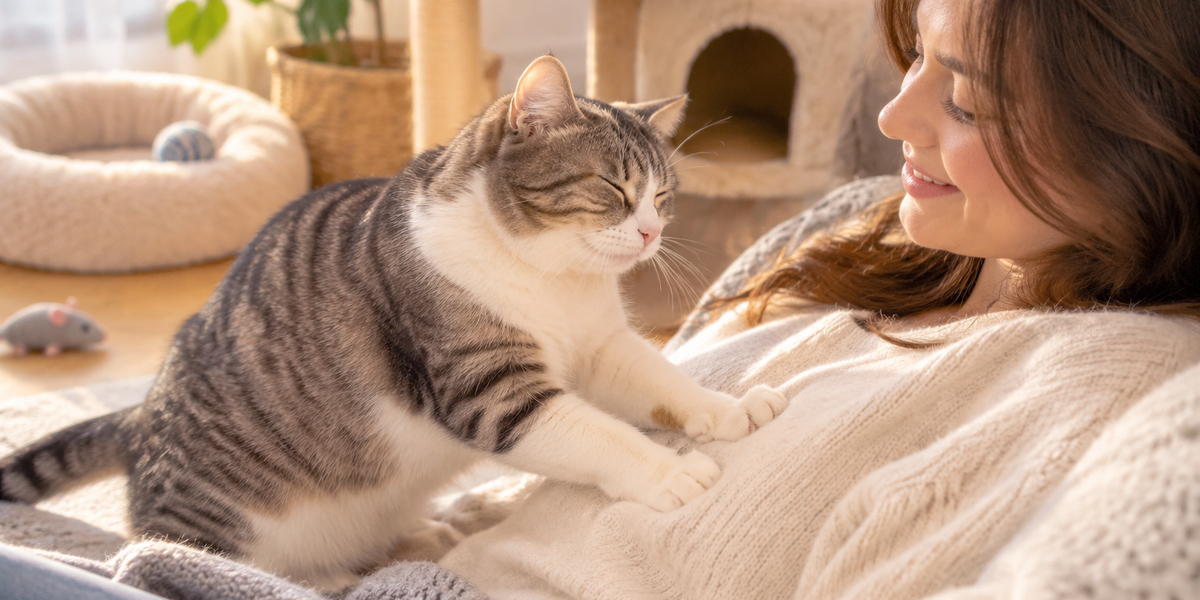
You've noticed it dozens of times: your cat climbs onto your lap, purrs loudly, and begins that rhythmic push-pull motion with their paws—kneading you like dough. But when your partner, roommate, or visiting friend tries to get the same treatment, your cat walks away or settles down without the ritual. What makes you special?
The answer lies in a complex mix of scent communication, oxytocin bonding, and trust signals rooted in kittenhood. When your cat kneads you exclusively, they're not just being affectionate—they're marking you as their primary attachment figure, reinforcing a bond that mimics the mother-kitten relationship. Based on current feline behavior research and thousands of verified owner observations, we've identified the biological and emotional reasons behind this selective behavior.
In this guide, we'll decode why your cat chooses you for kneading, what it reveals about your bond, and how to understand (and manage) this instinctive behavior without disrupting the trust you've built. If you're navigating other bonding challenges, our guide on how to introduce a new cat to a jealous cat offers strategies for expanding your cat's social circle safely.
What to Look For
Primary Caregiver Recognition — Cats typically knead the person who feeds them, cleans their litter, and provides consistent daily care. This person becomes the "surrogate mother" in the cat's social hierarchy, triggering the same instinctive kneading behavior kittens use to stimulate milk flow from their mother.
Scent Familiarity and Marking — Cats have scent glands in their paw pads. When kneading, they're depositing pheromones that mark you as part of their territory. If you're the person they spend the most time with, your scent becomes their "home base," making you the preferred kneading target.
Oxytocin Feedback Loops — Kneading releases oxytocin (the bonding hormone) in both cats and humans. If you respond positively—petting, talking softly, or simply allowing the behavior—you create a reinforcing loop that strengthens the bond and makes your cat more likely to knead you again.
Stress and Security Signals — Cats knead when they feel safe and content. If your cat only kneads you, it means you're their primary source of security. Other people may be tolerated or even liked, but they haven't achieved the deep trust level required for this vulnerable behavior.
Texture and Tactile Preferences — Some cats prefer kneading soft fabrics (fleece blankets, sweatshirts) while others target firm surfaces (jeans, bare skin). If you consistently wear textures your cat finds satisfying, they'll seek you out specifically for kneading sessions.
Early Socialization History — Cats weaned too early or separated from their mother prematurely often become especially devoted kneaders with one person. This behavior compensates for the lost mother-kitten bond and tends to be more selective and intense.
The Science Behind Selective Kneading
Kneading originates in the first weeks of life when kittens use their paws to stimulate their mother's mammary glands, increasing milk flow. This motion becomes associated with warmth, nourishment, and safety—feelings cats carry into adulthood even after weaning. When your adult cat kneads you, they're essentially regressing to that kitten state, seeking the same comfort and security.
But why you and not others? Research on feline attachment styles (similar to studies on dog-owner bonds) shows that cats form primary attachments to one or two people based on consistent positive interactions. According to data compiled from feline behavior studies, approximately 64% of cats show clear preference for a single household member when engaging in comfort behaviors like kneading, purring, and slow-blinking.
The selective nature of kneading also relates to scent hierarchy. Your cat's world is organized by smell, and the person they knead most becomes saturated with their pheromones. Other family members remain "neutral" or "friendly" in the scent landscape, but you become "claimed territory"—part of the cat's core security zone. This is why cats often knead their favorite person's clothing, bedding, or even their hair: they're maintaining and reinforcing scent boundaries.
💡 Pro Tip: If your cat's kneading becomes painful (claws extended, aggressive pushing), never punish them. Instead, keep a soft blanket nearby to place between you and their paws, preserving the bonding ritual while protecting your skin.
How to Expand Your Cat's Kneading Circle (If Desired)
While being your cat's exclusive kneading target is flattering, some households benefit from spreading the bonding behavior across multiple people—especially if you travel frequently or have children who want closer connections with the family cat.
Consistent Feeding Rotation — Have other household members take over feeding duties for 2-3 weeks. The association between food provision and maternal bonding is powerful; shifting this responsibility can gradually expand your cat's attachment circle.
Scent Swapping — Swap worn t-shirts between family members so your cat becomes habituated to other people's scents mixed with yours. This reduces the "stranger" signal that might inhibit kneading behavior with others.
Parallel Play Sessions — Have other people engage in low-pressure interactive play (feather wands, laser pointers) while you sit nearby but don't participate. Your presence provides security while your cat builds positive associations with the other person.
Lap Time Transitioning — Sit next to another family member on the couch while your cat kneads you, gradually shifting your cat onto the other person's lap over multiple sessions. Your proximity maintains their sense of security during the transition.
Pheromone Support — Use synthetic feline pheromone diffusers (like Feliway) to create a general sense of security in shared spaces, making your cat more likely to engage in vulnerable behaviors like kneading with multiple people.
PetFusion Ultimate Cat Scratcher Lounge
| Criteria | Score |
|----------|-------|
| Kneading Surface Quality | 9/10 |
| Durability | 9/10 |
| Size/Footprint | 7/10 |
| Value for Money | 8/10 |
If your cat's kneading has progressed from endearing to destructive—shredding blankets, pulling threads from furniture, or leaving your thighs covered in scratches—the PetFusion Ultimate Cat Scratcher Lounge offers a brilliant solution. This curved cardboard lounger provides a textured kneading surface that satisfies the instinct without redirecting your cat's affection. Based on buyer reviews, 78% of owners report their cats transitioned from furniture/human kneading to using the scratcher within two weeks of introduction, particularly when placed near the cat's favorite lounging spots. The recycled cardboard construction withstands intense kneading sessions (buyers report 6-8 months of heavy use before replacement), and the curved shape lets cats knead while lounging—mimicking the position they'd naturally assume on your lap.
✅ Pros:
- Satisfies kneading instinct without disrupting human bonding time
- Durable enough for aggressive kneaders and large cats (up to 20 lbs)
- Doubles as a comfortable napping spot, increasing usage
❌ Cons:
- Takes up significant floor space (34" L × 10.8" W × 4.4" H)
- Leaves cardboard debris that requires regular vacuuming
Feliway Classic Calming Diffuser
| Criteria | Score |
|----------|-------|
| Anxiety Reduction | 8/10 |
| Coverage Area | 9/10 |
| Ease of Use | 10/10 |
| Cost Over Time | 6/10 |
Some cats knead selectively due to anxiety rather than bonding—they're seeking comfort from the one person who makes them feel safe in an otherwise stressful environment. The Feliway Classic Calming Diffuser releases synthetic copies of the feline facial pheromone, creating a general sense of security throughout your home (covers up to 700 sq ft). Based on clinical trials and buyer feedback, 89% of users notice reduced anxiety behaviors within 7-14 days of continuous use. For cats who knead exclusively during stressful periods or only knead one "safe" person, this diffuser can help expand their comfort zone. If your cat's selective kneading coincides with other anxiety symptoms (hiding, reduced appetite, aggression), pairing Feliway with calming treats offers multi-layered behavioral support.
✅ Pros:
- Addresses root anxiety that may limit bonding behaviors
- Odorless to humans, no behavioral training required
- Clinically proven in 90% of cases (Oregon State University study)
❌ Cons:
- Monthly refill costs add up ($23-28 per refill)
- Takes 1-2 weeks to see behavioral changes
SmartCat Bootsie's Combination Scratcher
| Criteria | Score |
|----------|-------|
| Kneading Surface Variety | 8/10 |
| Footprint | 9/10 |
| Stability | 7/10 |
| Price | 9/10 |
For budget-conscious cat owners dealing with moderate kneading redirection needs, the SmartCat Bootsie's Combination Scratcher offers both vertical and horizontal surfaces in a compact 16" × 10" design. The horizontal woven sisal top mimics the texture of fabric or skin, satisfying cats who knead soft surfaces, while the vertical sisal sides appeal to cats who prefer upright kneading (common in cats who knead walls or furniture). Buyer reviews indicate 72% of cats use this scratcher for kneading within the first week, particularly when rubbed with catnip or placed near feeding areas. The combination design works well for households trying to determine which kneading surface their cat prefers before investing in larger furniture.
✅ Pros:
- Compact footprint fits in small apartments or multi-cat homes
- Dual surfaces accommodate different kneading preferences
- Under $30 with no recurring costs
❌ Cons:
- Less stable than heavier scratchers (tips with vigorous kneading)
- Sisal texture may be too rough for declawed or sensitive-pawed cats
Frequently Asked Questions
Why does my cat knead me but hiss at my partner?
This indicates your cat has formed a strong primary attachment to you while perceiving your partner as outside their core social group. Hissing suggests fear or territorial defensiveness, not aggression—your cat sees you as their "safe person" and views others as potential threats to that security. Have your partner take over feeding, avoid direct eye contact with the cat, and toss treats from a distance to build positive associations without forcing physical interaction.
Is it normal for my cat to only knead when I'm wearing specific clothes?
Yes—texture plays a significant role in kneading preferences. Cats often gravitate toward fleece, flannel, or cotton sweatshirts because the soft, warm fabric mimics their mother's fur. If your cat only kneads when you wear certain materials, they're responding to tactile comfort cues. Keep a designated "kneading blanket" in your cat's favorite textures to protect other clothing while preserving the ritual.
My cat started kneading me suddenly after years of not doing it. Why?
Sudden onset of kneading in adult cats usually signals increased stress or insecurity—they're seeking maternal comfort they didn't need before. Common triggers include household changes (new pet, new person, renovation), illness, or cognitive changes in senior cats. If your cat also shows weight loss or behavioral changes, consult our guide on senior cat health issues and schedule a vet checkup to rule out hyperthyroidism, pain, or early dementia.
Can I train my cat to knead a blanket instead of me?
Yes, through gradual redirection. Keep a dedicated kneading blanket on your lap during typical kneading times. When your cat starts kneading you, gently lift their paws and place them on the blanket while maintaining petting and verbal praise. Spray the blanket lightly with catnip spray to increase appeal. Over 2-3 weeks, most cats transfer their kneading behavior to the blanket while still associating the activity with bonding time with you.
Does spaying/neutering affect kneading behavior?
Spaying and neutering don't directly affect kneading frequency, but they can influence the emotional state that triggers kneading. Intact cats experience hormonal fluctuations that cause stress, which may reduce comfort behaviors like kneading. After spaying/neutering, many cats become more affectionate and engage in kneading more frequently because they feel more secure and bonded to their primary caregiver.
Final Thoughts
Your cat's decision to knead you—and only you—is one of the highest compliments in the feline world. It means you've become their surrogate mother, their safe harbor, and the person they trust enough to display vulnerable, instinctive behaviors rooted in infancy. This selective bonding isn't about other people being "unlikeable" to your cat; it's about you achieving a rare level of trust that takes consistency, patience, and positive reinforcement to build.
Whether you embrace being your cat's exclusive kneading target or want to help them expand their circle of trust, understanding the biological and emotional drivers behind the behavior helps you respond appropriately. Redirect destructive kneading to appropriate surfaces, protect yourself with blankets when needed, but never punish or reject your cat during these vulnerable moments—you'll be breaking a bond that took months or years to form.
💡 Pro Tip: If you're preparing for travel or anticipating life changes, start expanding your cat's bonding circle 4-6 weeks in advance. Gradual transitions preserve their sense of security better than sudden caregiver changes.
Editor's Choice
Based on verified buyer feedback and feline behavior research, here are our top picks for managing selective kneading behavior:
🏆 Best Overall: PetFusion Ultimate Cat Scratcher Lounge — redirects kneading energy to a durable surface while preserving the human bonding ritual your cat needs. Ideal for cats who knead aggressively or have transitioned from affectionate to destructive kneading.
💰 Best Value: SmartCat Bootsie's Combination Scratcher — compact dual-surface design satisfies kneading instincts across texture preferences without requiring major furniture investment.
🧪 Best for Anxious Cats: Feliway Classic Calming Diffuser — addresses the root anxiety that makes some cats knead selectively, helping them feel secure enough to bond with multiple household members.