We earn a commission if you make a purchase, at no additional cost to you.
⭐ Our Top Pick
🏆 Best Overall: Catit Senses 2.0 Food Tree — vertical puzzle design keeps cats engaged longer with adjustable difficulty levels.
💰 Best Value: PetSafe SlimCat Interactive Feeder — rock-bottom price gets your cat moving and thinking without the commitment.
Introduction
Your indoor cat sleeps 18 hours a day, demolishes their food in 90 seconds flat, and spends the rest of their waking hours staring at walls or knocking things off counters. Sound familiar? Boredom isn't just annoying for you—it's genuinely harmful for cats, leading to obesity, anxiety, destructive behavior, and even depression.
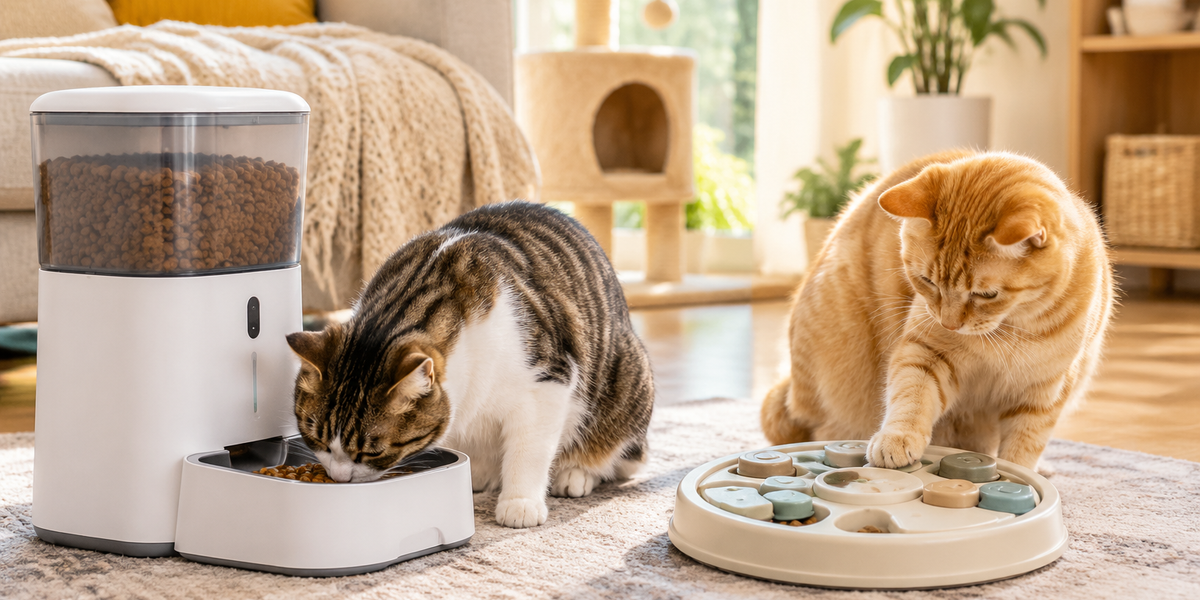
The feeding bowl debate has evolved beyond wet versus dry. In 2026, cat parents are choosing between two fundamentally different approaches to mealtime enrichment: smart feeders that automate portion control and scheduling, and puzzle feeders that transform eating into a mentally stimulating hunt. We researched both categories, comparing manufacturer specs and thousands of verified buyer reviews to help you decide which approach fits your cat's personality and your household routine.
This guide breaks down the core differences, walks through what actually matters when choosing either type, and reviews top-performing models in each category. If you're also exploring tech solutions for your cat's environment, our Best WiFi Pet Cameras with Treat Dispenser AND Laser Pointer 2026 guide covers another angle of interactive enrichment.
What to Look For
Mental Stimulation Approach: Puzzle feeders engage natural hunting and foraging instincts by making cats work for food—pawing, nudging, problem-solving. Smart feeders provide enrichment through routine predictability and portion control, which reduces food anxiety but doesn't directly engage cognitive skills. Consider your goal: behavioral enrichment (puzzle) or schedule management (smart).
Your Cat's Food Motivation Level: Highly food-motivated cats thrive with puzzle feeders because the reward justifies the effort. Grazers or picky eaters may get frustrated and walk away, making timed smart feeders a better fit. Buyer reviews consistently show puzzle feeder success correlates directly with how treat-obsessed your cat is.
Ease of Cleaning: Puzzle feeders with multiple compartments, narrow openings, or textured surfaces trap kibble dust and oils—daily washing is non-negotiable. Smart feeders have fewer nooks but require periodic deep-cleaning of hoppers and dispensing mechanisms. Dishwasher-safe components are a major convenience factor for either type.
Difficulty Adjustability: The best puzzle feeders let you start easy and increase challenge as your cat masters each level. Smart feeders should allow flexible scheduling (not just fixed intervals) and portion customization per meal. Rigid systems lead to frustration or boredom within weeks.
Capacity vs Household Size: Puzzle feeders typically hold a single meal's worth of kibble (1/4 to 1/2 cup). Smart feeders range from 3L to 7L hoppers—critical if you have multiple cats or travel frequently. Match capacity to your refill tolerance and the number of mouths you're feeding.
App Control and Backup Power (Smart Feeders): WiFi connectivity lets you adjust schedules remotely, but requires stable 2.4GHz networks. Battery backup prevents missed meals during outages. Buyer reviews flag connectivity dropouts and power failures as top frustrations—verify both features before buying.
💡 Pro Tip: Start with a simple, inexpensive puzzle feeder to test your cat's interest before investing in complex designs or automated systems. Many cats need 2-3 days to understand the concept.
Catit Senses 2.0 Food Tree — Best Overall Puzzle Feeder
| Criteria | Score |
|----------|-------|
| Engagement Level | 9/10 |
| Difficulty Adjustability | 8/10 |
| Build Quality | 8/10 |
| Ease of Cleaning | 7/10 |
The Catit Food Tree combines vertical foraging with adjustable challenge levels across three tiers. Cats must reach through side openings to bat kibble down level by level—mimicking the problem-solving of hunting prey in tight spaces. The transparent design lets you monitor how much food remains and observe your cat's technique, which helps you gauge when to increase difficulty by narrowing the openings.
Buyer reviews consistently praise long-term engagement that other flat puzzle feeders don't maintain. The stable base and quality plastic construction hold up to aggressive paw-slappers, though the narrow tubes between levels require a bottle brush for thorough cleaning. At under $25, it delivers serious mental stimulation without the price tag of automated tech.
✅ Pros:
- Multi-level challenge keeps interest high across weeks and months
- Transparent design lets you monitor food levels and progress
- Stable base withstands vigorous batting without tipping
❌ Cons:
- Narrow internal tubes are challenging to clean thoroughly
- Requires daily refilling for highly food-motivated cats
PetSafe SlimCat Interactive Feeder — Best Budget Puzzle Option
| Criteria | Score |
|----------|-------|
| Engagement Level | 7/10 |
| Difficulty Adjustability | 6/10 |
| Build Quality | 7/10 |
| Ease of Cleaning | 9/10 |
This ball-style puzzle feeder gets your cat moving—they chase it around to dispense kibble through adjustable openings. It's dead simple: fill it, set the hole size, and let your cat figure out that movement equals food. The SlimCat shines as a gateway puzzle feeder because the learning curve is gentle and the price point removes any risk.
The design encourages physical activity alongside mental engagement, making it ideal for overweight indoor cats who need movement motivation. Buyer reviews note that it works best on hard floors where it rolls freely (carpet dampens the action), and the plastic can be noisy during late-night hunting sessions. It's dishwasher-safe and nearly indestructible—a smart starter option before committing to more complex systems.
✅ Pros:
- Incredibly affordable entry point under $6
- Combines mental stimulation with physical exercise
- Dishwasher safe and built to last
❌ Cons:
- Plastic-on-hardwood noise can be disruptive
- Limited capacity means frequent refills for multi-cat homes
PETLIBRO Automatic Cat Feeder — Best Smart Feeder for Reliability
| Criteria | Score |
|----------|-------|
| Schedule Flexibility | 9/10 |
| Portion Accuracy | 9/10 |
| App Usability | 8/10 |
| Backup Reliability | 9/10 |
The PETLIBRO represents the smart feeder approach: precise portions at scheduled times, controlled via smartphone app. The 5-liter hopper holds weeks of kibble for a single cat, and you can program up to six meals per day with customizable portion sizes. The dual-power system (plug-in plus battery backup) prevents the nightmare scenario of missed meals during power outages—a feature verified buyers call essential.
The WiFi app lets you adjust feeding times on the go, useful when your schedule shifts or you're traveling. The built-in camera and two-way audio require a subscription after the trial period, but the core feeding functions work without ongoing fees. Buyer reviews consistently rate this model for reliable dispensing without jams, though the 2.4GHz WiFi requirement causes initial setup headaches for some users on newer mesh systems.
✅ Pros:
- Dual power backup ensures no missed meals during outages
- Large 5L capacity reduces refill frequency
- Accurate portion control helps manage weight
❌ Cons:
- Requires 2.4GHz WiFi network (5GHz not supported)
- Camera and audio features require monthly subscription
Trixie Activity Fun Board — Best Variety Puzzle Feeder
| Criteria | Score |
|----------|-------|
| Engagement Level | 8/10 |
| Difficulty Range | 9/10 |
| Build Quality | 7/10 |
| Ease of Cleaning | 6/10 |
The Trixie Fun Board is a sampler platter of puzzle types on one flat tray: tunnels, pegs, sliders, cups, and grooves. This variety helps you discover which challenge style your cat prefers before investing in a specialized feeder. The low-profile design works for cats of all ages and mobility levels, including seniors who can't navigate vertical puzzles.
Buyer reviews highlight this as an excellent introduction for puzzle-hesitant cats—you can start with treats in the easiest compartments and gradually hide kibble in tougher spots. The multiple puzzle types prevent boredom longer than single-mechanism feeders. The trade-off is cleaning: five different compartment styles mean five different cleaning challenges, and the textured surfaces trap oils. Supervision is recommended initially to prevent frustration.
✅ Pros:
- Five distinct puzzle types let you test preferences
- Low profile accommodates cats with mobility limitations
- Gentle learning curve for puzzle-shy cats
❌ Cons:
- Multiple compartments make thorough cleaning tedious
- Not suitable for aggressive eaters who may tip it
Smart Feeder vs Puzzle Feeder: Key Differences
Smart feeders and puzzle feeders solve different problems. Smart feeders excel at schedule consistency, portion control for weight management, and convenience when you travel or work irregular hours. They're the right choice if your primary goal is feeding automation or if your cat is a grazer who gets anxious about food availability. Pairing a smart feeder with a separate interactive toy can address mental stimulation needs independently.
Puzzle feeders directly target boredom and natural foraging instincts. They slow down fast eaters, provide cognitive engagement, and turn mealtime into an activity. They're ideal for food-motivated, energetic cats who need mental challenges, or as a supplement to regular bowls for enrichment without fully automating feeding. The trade-off is hands-on involvement—you're refilling daily and supervising initially.
💡 Pro Tip: Many cat behaviorists recommend using both: a smart feeder for main meals to establish routine, plus a puzzle feeder for a portion of daily food to add enrichment. This hybrid approach combines reliability with mental stimulation.
Frequently Asked Questions
Can I use a puzzle feeder for wet food?
Most puzzle feeders are designed for dry kibble only—wet food clogs mechanisms and creates sanitation issues. A few models like lick mats or shallow maze trays work with wet food, but require immediate post-meal cleaning to prevent bacterial growth. If your cat eats primarily wet food, look for slow-feeder bowls with raised obstacles instead of enclosed puzzle designs.
Will a smart feeder work during a WiFi outage?
Yes, with important caveats. Most smart feeders store your programmed schedule locally and will continue dispensing on time even without internet connectivity. You lose remote control and notifications during the outage, but the core feeding function persists. Battery backup is separate from WiFi—it keeps the feeder running during power outages regardless of internet status.
How long does it take cats to learn puzzle feeders?
Most food-motivated cats figure out basic puzzle feeders within 2-3 feeding sessions. Start by placing some kibble in plain sight on top of the puzzle, then gradually hide more inside as they understand the concept. Timid or less food-driven cats may take a week of encouragement. Buyer reviews suggest starting with the easiest difficulty setting and never forcing it—some cats simply prefer traditional bowls.
Do smart feeders help with weight loss?
Smart feeders enable weight loss by enforcing portion control and preventing free-feeding, but they're a tool, not a solution. You still need to calculate appropriate daily calories and divide them across meals. The advantage over manual feeding is consistency—no more overpouring or giving in to begging. Pair portion control with increased activity for best results, and consult your vet for target weights and calorie needs.
Can multiple cats share one puzzle feeder?
Physically yes, but behaviorally it's complicated. Food-aggressive cats may guard the puzzle feeder and prevent timid cats from accessing it, defeating the enrichment purpose. If your cats eat peacefully from the same bowl, they'll likely share a puzzle feeder—but monitor initial sessions. For households with food competition, individual puzzle feeders in separate areas work better, or use a smart feeder for main meals and puzzle feeders for supplemental treats.
Final Thoughts
The smart feeder versus puzzle feeder decision comes down to your primary goal. If you need feeding automation, travel frequently, or have a cat with food anxiety who thrives on predictable routine, a smart feeder like the PETLIBRO delivers reliable portion control and schedule management. If your cat is bored, overweight from eating too fast, or simply needs more mental engagement during the day, a puzzle feeder like the Catit Senses 2.0 Food Tree taps into natural hunting instincts and transforms mealtime into enrichment.
Many cat parents find the hybrid approach most effective: automate main meals for consistency, then use puzzle feeders for a portion of daily food or high-value treats. This combines the convenience of smart feeding with the cognitive benefits of foraging challenges. Whichever path you choose, the worst option is leaving your intelligent indoor predator with nothing but a bowl that empties in seconds—both technologies represent meaningful upgrades for feline mental health and household harmony.
Editor's Choice
After comparing specs and verified buyer feedback across both categories, we recommend the Catit Senses 2.0 Food Tree for most indoor cats seeking mental stimulation. The vertical puzzle design maintains interest far longer than flat alternatives, and the adjustable difficulty grows with your cat's skills. At $25, it's accessible enough to try risk-free.
For budget-conscious households or puzzle-feeder beginners, the PetSafe SlimCat Interactive Feeder delivers surprising value under $6—it combines mental engagement with physical activity and survives years of aggressive play.
If feeding automation is your priority, the PETLIBRO Automatic Cat Feeder offers the reliability and portion accuracy that smart feeders promise but don't always deliver, with dual-power backup that prevents the missed-meal anxiety cheaper models create.