Introduction
Indoor cats live longer, safer lives — but safety comes with a trade-off. Without trees to climb, prey to hunt, or territory to patrol, a house cat can quickly become bored, anxious, or destructive. If your cat is knocking things off shelves at 2 a.m. or over-grooming, those aren't personality quirks — they're cries for stimulation.
At MeowPod, we've spent years researching feline behavior and talking to veterinary behaviorists. The consensus is clear: mental and physical enrichment is just as important as food and water for a cat's wellbeing. A stimulated cat is a calmer, healthier, happier companion.
In this guide we'll walk through 12 practical enrichment ideas you can start implementing today — from free DIY setups to a few well-chosen products — so your indoor cat can thrive in 2026 and beyond.
12 Enrichment Ideas for Your Indoor Cat
1. Set Up a Window Perch
Cats are hard-wired to observe their environment from height. A window perch gives your cat a "cat TV" experience — birds, squirrels, passing cars — for hours of passive entertainment. Add a bird feeder outside the window to dramatically increase programming.
2. Use Puzzle Feeders
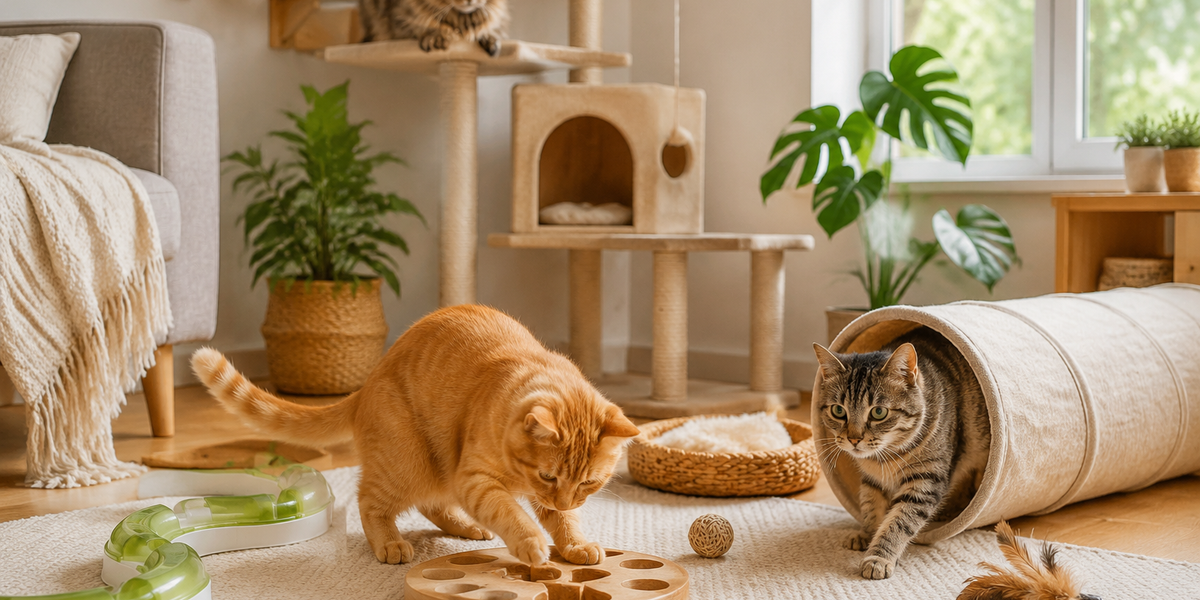
Replacing your cat's bowl with a puzzle feeder is one of the highest-impact changes you can make. It engages hunting instincts, slows eating, and prevents boredom — all at once. Start with a simple level-1 puzzle and work up to more complex designs.
💡 Pro Tip: Rotate between two or three different puzzle feeders weekly. Novelty is half the enrichment value — a puzzle your cat has "solved" provides little mental challenge.
3. Schedule Daily Interactive Play
No gadget replaces the bond of play with you. Aim for two 10–15 minute sessions per day using a wand toy. Mimic real prey movement: dart the toy under a blanket, twitch it slowly, let your cat "catch" it. Always end the session with a catch so your cat feels satisfied.
4. Build or Buy a Cat Tree
Vertical space is territory. A sturdy cat tree with multiple levels, scratching posts, and a high perch lets your cat own their environment. Place it near a window for double enrichment value.
5. Try Clicker Training
Cats are absolutely trainable, and learning tricks provides powerful cognitive enrichment. Use a clicker and small treat pieces to teach sit, high-five, or spin. Five minutes a day is enough — short sessions prevent frustration.
6. Introduce a Cat Grass or Herb Garden
Grow cat grass, valerian, or silver vine in a planter on the floor or windowsill. These plants provide sensory enrichment — scent, texture, and taste — and cat grass aids digestion. Silver vine is particularly effective for cats that don't respond to catnip.
7. Rotate Toys Regularly
A toy your cat ignores is usually a toy they've habituated to, not one they dislike. Store half your cat's toys away and swap them out every few days. Reintroducing a "forgotten" toy often reignites enthusiastic play.
8. Create Foraging Opportunities
Scatter a portion of your cat's dry food around the room, or hide small portions in cardboard boxes and paper bags. This encourages natural foraging behavior and turns a 30-second meal into a 20-minute activity.
9. Provide Scratching Variety
Cats scratch to mark territory, stretch muscles, and maintain claws. Offer both horizontal and vertical scratching surfaces made from different materials (sisal, cardboard, carpet). Placing a scratcher near sleeping spots and entry points to rooms satisfies territorial scratching instincts.
10. Add a Bird or Fish to Watch
A fish tank with a secure lid or a caged bird placed safely out of reach gives your cat an endlessly stimulating focal point. Even a small betta tank can keep a cat entertained for hours — just ensure your cat cannot stress or harm the other animal.
11. Use Food-Dispensing Toys and Apps
Several apps and YouTube channels offer hours of "bird and mouse" videos designed specifically for cats. Play them on a tablet propped at cat height. Pair with a food-dispensing ball to engage both mind and body simultaneously.
12. Consider a Second Cat
For cats that exhibit loneliness signs — excessive vocalization, clinginess, or depression when you leave — a feline companion is often the best long-term solution. Introduce a new cat slowly using scent swapping before any face-to-face meetings.
Common Mistakes to Avoid
- All enrichment, no rest: Cats sleep 12–16 hours a day by design. Overstimulation causes stress — balance activity with quiet downtime zones.
- Unsafe toys unsupervised: Wand toys with strings should be put away after play sessions. Ingested string is a veterinary emergency.
- Ignoring scent enrichment: We focus on sight and sound, but cats experience the world primarily through smell. Rotating in new scents — a pinecone from outside, a paper bag from the grocery store — is free and highly effective.
- Giving up on puzzle feeders too fast: Some cats need a week to engage. Start with the easiest level and make the food reward irresistible.
💡 Pro Tip: Observe which enrichment your specific cat gravitates toward and double down on it. A cat obsessed with chasing small fast toys needs more wand play; a cat that loves sitting in bags needs more foraging setups. Individual personality matters more than any general rule.
Frequently Asked Questions
How much playtime does an indoor cat need per day?
Most adult cats benefit from at least two dedicated 10–15 minute interactive play sessions daily. Kittens and high-energy breeds like Bengals or Abyssinians may need more. Watch for zoomies, attention-seeking, or nighttime activity as signs your cat needs more play.
My cat seems lazy and uninterested in toys. Is that normal?
Some cats are naturally lower energy, but sudden disinterest in play can signal health issues, depression, or pain — especially in older cats. If the change is sudden, a vet visit is warranted. For chronically low-engagement cats, try experimenting with different toy types; many "lazy" cats go wild for feather wands even if they ignore ball toys.
Is it cruel to keep a cat indoors?
Not at all — provided you meet their enrichment needs. Indoor cats live on average 12–18 years versus 2–5 years for outdoor cats. The key is creating an environment rich enough to satisfy natural instincts without outdoor access.
Do cats really benefit from training?
Absolutely. Training provides cognitive challenge, strengthens your bond, builds your cat's confidence, and makes veterinary handling easier. Even elderly cats can learn new behaviors.
How do I introduce a second cat without fighting?
Slow introductions are essential. Separate the cats completely for at least a week, swapping bedding to share scents. Feed them on opposite sides of a closed door so they associate each other's smell with positive experiences. Gradually increase visual contact before allowing physical meetings.
Final Thoughts
Keeping an indoor cat truly happy isn't complicated — it just takes consistency and a willingness to see the world from your cat's perspective. Start with one or two ideas from this list this week, observe your cat's response, and build from there. You don't need to overhaul your home overnight.
The payoff is real: a mentally stimulated cat is less destructive, less anxious, more affectionate, and more fun to live with. We've seen it time and again — small, regular enrichment investments pay dividends in years of joyful companionship. Your cat is counting on you, and you've clearly already got the right instincts by being here. Happy enriching!