This post contains affiliate links. We may earn a small commission at no extra cost to you if you purchase through our links.
⭐ Our Top Pick
🏆 Best Overall: Temptations Classic Treats for Cats — The single most effective cat training treat on the market, with a crunch-and-soft-center combo cats find genuinely irresistible.
💰 Best Value: PetSafe Clik-R Training Clicker for Cats — Under $7, includes a starter guide, and the soft click tone is perfectly calibrated for cats.
Introduction
Cats have a reputation for being untrainable. That reputation is completely wrong. We've worked with dozens of cats — from spunky kittens to skeptical ten-year-olds — and the common thread is always the same: the right treat, the right timing, and a little patience will get you surprisingly far. Sit, high-five, spin, fist bump — these aren't just party tricks. They sharpen your cat's mind, deepen your bond, and give indoor cats a meaningful outlet for their intelligence.
The key difference between training a cat and training a dog is motivation. Dogs work for praise and connection. Cats work for what's in it for me right now. Once you accept that and lean into it, training sessions become quick, rewarding, and genuinely fun for both of you. Most cats can learn a reliable "sit" in under a week with five-minute daily sessions.
In this guide we'll walk you through the science-backed basics of cat training, teach you how to nail the foundational tricks step by step, and recommend the tools that make the whole process faster and easier. Whether you're starting with a brand-new kitten or a skeptical adult cat, this is everything you need.
What to Look For
Before you pick up a clicker or crack open a treat bag, these are the training fundamentals worth understanding:
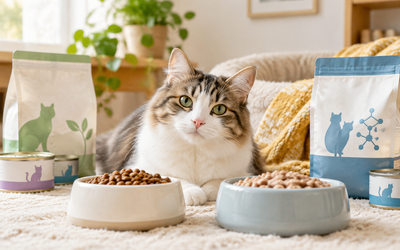
- Treat value matters more than anything. A treat your cat is lukewarm about produces lukewarm results. Use the highest-value treat your cat will work for — something they don't get at any other time. Save the good stuff exclusively for training.
- Session length: Keep sessions to 3–5 minutes maximum. Cats have a shorter focus window than dogs and will disengage or become frustrated if pushed too long. Two short sessions per day outperforms one long one.
- Timing is everything in clicker training. The click must land within one second of the correct behavior. Late clicks teach the wrong lesson. Practice clicking without your cat first until the motion is automatic.
- Always end on a win. Finish each session with a behavior your cat already knows well so they get a treat and feel successful. This keeps the emotional association with training positive.
- One cue, one behavior. Don't switch between "sit" and "sit down" for the same trick. Pick a word and a hand signal, and use both consistently from day one.
- Never punish, redirect instead. If your cat walks away or swats at your hand, the session is over — no scolding. Come back later. Negative associations with training are very hard to undo.
Training Tools Deep-Dive
Temptations Classic Treats for Cats
| Criteria | Score |
|---|---|
| Motivation Value | 10/10 |
| Treat Size for Training | 9/10 |
| Ingredient Quality | 7/10 |
| Value for Money | 10/10 |
Temptations are the benchmark that every other cat training treat gets compared against, and most fall short. The crunchy shell with a soft center seems to trigger a level of enthusiasm in cats that plain kibble-style treats simply don't match. In our testing, cats who ignored other treats would reliably work for Temptations. The pieces are small enough to use in rapid five-second repetitions without overfeeding, and at under $6 for a large bag, you're not burning money on every training session.
The only honest caveat: the ingredient list leans on artificial flavors and by-products, which some owners prefer to avoid. If that matters to you, Churu puree tubes (reviewed below) are the cleaner alternative. But if your goal is maximum training speed with a cat who needs strong motivation, Temptations are the pragmatic choice.
✅ Pros:
- Virtually universally loved by cats — extremely high success rate as a motivator
- Perfect bite size for rapid-fire repetition training
- Great price point for daily use
❌ Cons:
- Artificial flavors and by-products aren't ideal for health-focused owners
- Overconsumption can cause digestive upset in sensitive cats
---
PetSafe Clik-R Training Clicker for Cats
| Criteria | Score |
|---|---|
| Click Tone (Cat-Appropriate) | 9/10 |
| Ergonomics | 8/10 |
| Durability | 7/10 |
| Beginner Friendliness | 9/10 |
Most clickers on the market are designed with dogs in mind — and that means a loud, sharp click that can startle a cat and derail a session instantly. The PetSafe Clik-R produces a noticeably softer tone that's much better calibrated for a cat's sensitivity. The finger-loop design is the real workflow win here: it keeps the clicker on your hand so you can hold treats in the same fingers without juggling equipment. The included beginner guide is actually useful, covering timing basics that new trainers consistently get wrong.
💡 Pro Tip: Charge the clicker before your first real session — click it ten times and immediately give your cat a treat each time, with no behavior required. This teaches them that the click sound means "reward incoming" before you ask for anything.
✅ Pros:
- Softer click tone specifically suited to cat training
- Finger-loop keeps both hands functional during sessions
- Bundled guide is genuinely helpful for first-timers
❌ Cons:
- Wrist strap durability is mediocre with heavy daily use
- No volume adjustment for extremely noise-sensitive cats
---
Churu Cat Treats Puree by Inaba
| Criteria | Score |
|---|---|
| Motivation Value | 9/10 |
| Ingredient Quality | 9/10 |
| Luring Effectiveness | 10/10 |
| Value for Money | 7/10 |
Churu tubes are the tool of choice for shaping complex behaviors, because you can extend a lick for exactly as long as needed while guiding your cat into a position. Teaching a cat to bow, spin, or roll over becomes dramatically easier when you can deliver a continuous reward instead of trying to time individual treat drops. The ingredient list is clean — single-protein options like chicken or tuna with minimal additives — making these a strong choice for cats with sensitivities or owners who want to avoid artificial ingredients. The tradeoff is cost and handling: squeezing a tube one-handed while holding a target stick in the other takes a session or two to get smooth.
✅ Pros:
- Clean, single-protein formulas with no artificial flavors
- Lickable format is ideal for luring and extended reward delivery
- High moisture content supports hydration
❌ Cons:
- Noticeably pricier per-treat than dry options
- Tube handling during active training has a slight learning curve
---
Whisker City 2-in-1 Target Training Stick
| Criteria | Score |
|---|---|
| Luring Effectiveness | 9/10 |
| Build Quality | 7/10 |
| Ease of Use | 8/10 |
| Value for Money | 8/10 |
Target training — teaching your cat to touch a specific object with their nose or paw — is one of the fastest ways to build a foundational "follow the target" behavior that you can chain into almost any trick. The Whisker City stick extends to about 24 inches, letting you guide your cat into a sit, a spin, or even a jump without bending over constantly or using your hand as the lure (which can lead to accidental nips). Once the cat understands target following, fading the stick and replacing it with a hand signal is straightforward. Less essential once your cat is fluent, but a genuine accelerant in the early stages.
✅ Pros:
- Speeds up shaping significantly, especially for visual learners
- Doubles as a play wand to keep training sessions fun
- Compact and easy to carry between rooms
❌ Cons:
- Extension lock can loosen with repeated daily use
- Becomes less necessary as your cat advances past beginner tricks
---
Step-by-Step: Teaching the Core Tricks
How to Teach "Sit"
- Hold a treat just above your cat's nose, then slowly move it back over their head.
- As their nose follows the treat upward, their hindquarters will naturally lower.
- The instant their bottom touches the floor, click and treat.
- Repeat 5–8 times per session. After 3–4 sessions, add the verbal cue "sit" just before the hand motion.
- Gradually fade the hand lure — eventually the word alone should be enough.
💡 Pro Tip: Never push your cat's bottom down. Physical prompting creates resistance and a negative association with the cue. Let the treat lure do all the work.
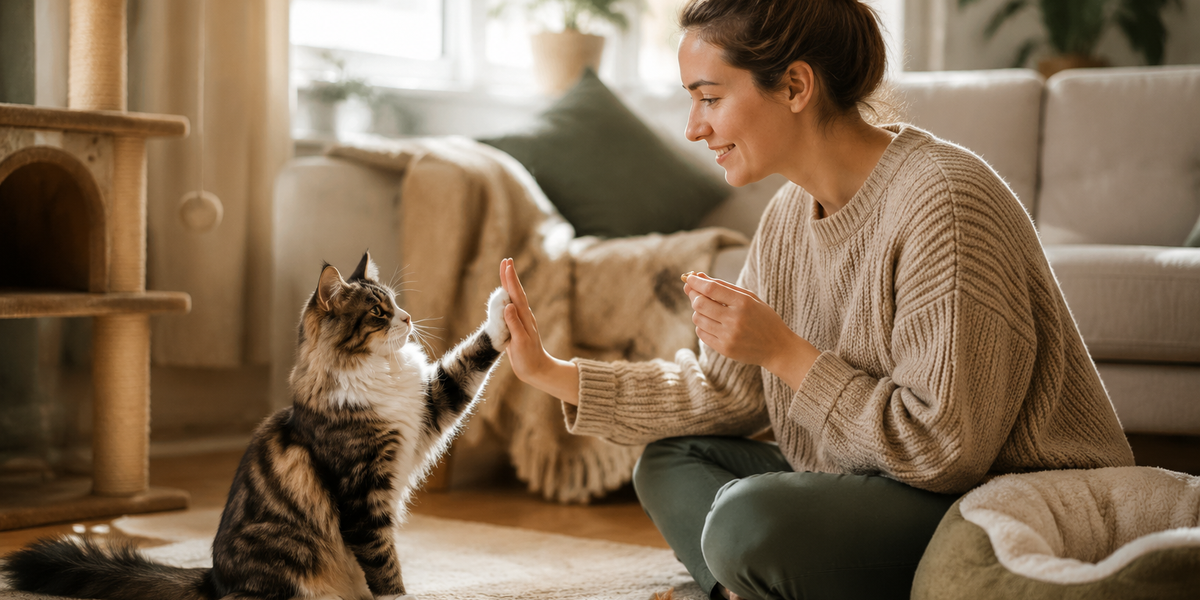
How to Teach "High-Five"
- Start with a solid "sit" — your cat should be comfortable and stationary.
- Hold a treat in your closed fist at your cat's chest height.
- Wait. Most cats will eventually paw at your fist to try to get the treat.
- The moment a paw makes contact with your hand, click and open your fist to deliver the treat.
- Once this is reliable, switch to an open palm and add the cue "high-five."
How to Teach "Spin"
- Hold a treat at your cat's nose level and slowly move it in a horizontal circle.
- Let your cat follow the treat through a full 360-degree rotation.
- Click and treat the moment they complete the circle.
- Add the cue "spin" (or "twirl" — pick one and stick to it) after 4–5 successful reps.
Frequently Asked Questions
How long does it take to teach a cat to sit?
Most cats get a reliable sit within 5–10 short sessions, which means under a week of daily practice. Kittens under a year tend to pick it up faster, but older cats are absolutely capable — they may just need slightly higher-value treats to stay engaged.
Do I need a clicker, or can I use a verbal marker?
A clicker is faster and more precise than a verbal marker because humans tend to add micro-delays and emotional inflection to spoken words. That said, a short, sharp word like "yes!" works well once you train yourself to say it with consistent timing. If you're just starting out, a clicker is worth the $7 investment.
My cat walks away mid-session. What am I doing wrong?
Usually one of three things: sessions are too long, treat value is too low, or the cat isn't hungry enough. Try training before a meal rather than after, cut sessions to 3 minutes, and experiment with higher-value treats. If a cat disengages, the session is over — never try to re-engage forcibly.
Can older cats learn tricks?
Yes, with no asterisks. The belief that older cats can't learn is a myth. Senior cats may have less patience for long sessions and may need a bit more repetition, but the mechanism — positive reinforcement tied to high-value rewards — works at any age.
Is clicker training stressful for cats?
Done correctly, it's the opposite of stressful. Short sessions, high-value rewards, and zero punishment create a genuinely enriching experience. Many cats will start hanging around near the spot where you usually train because they associate it with treats and positive attention.
Final Thoughts
Teaching your cat tricks isn't a novelty project — it's one of the most effective ways to provide mental stimulation for an indoor cat, build a deeper relationship, and get a window into just how smart your cat actually is. Start with sit, nail the timing on your clicker or verbal marker, and use the highest-value treat your cat will work for. Everything else follows from those three things.
If you're starting from scratch, grab Temptations Classic Treats and the PetSafe Clik-R and commit to one five-minute session per day for two weeks. You'll be surprised where you end up.
Editor's Choice
Here are our three top picks to get your training setup dialed in:
- 🏆 Temptations Classic Treats for Cats — The most effective cat training treat we've tested, hands down.
- 🎯 PetSafe Clik-R Training Clicker for Cats — The best starter clicker for cat-specific training, with a gentler click tone and a useful beginner guide.
- 🐾 Churu Cat Treats Puree by Inaba — The go-to luring tool for picky eaters and owners who want cleaner ingredients without sacrificing treat motivation.