We may earn a commission if you make a purchase through our links, at no extra cost to you.
⭐ Our Top Pick
🏆 Best Overall: PetSafe Drinkwell Platinum — adjustable flow, large capacity, and proven track record make this the top choice for most cat owners.
💰 Best Value: Catit Flower Fountain — quiet, compact, and under $30 with all the core filtration benefits.
Introduction
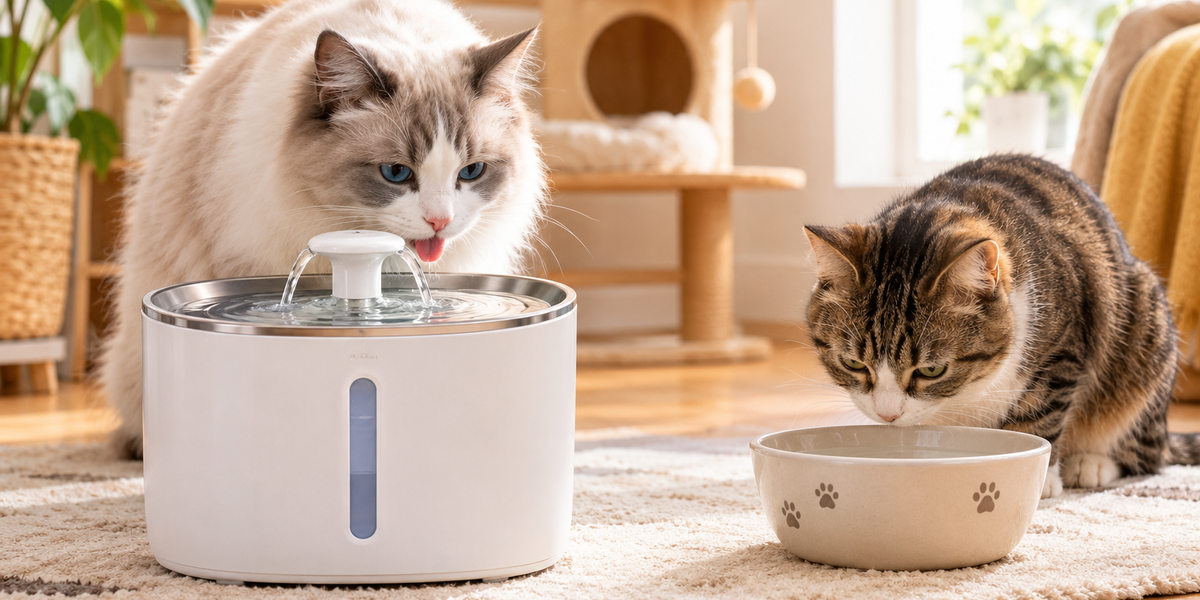
Your cat ignores the ceramic bowl you filled this morning, but races to drink from the bathroom faucet every chance they get. Sound familiar? This instinctive behavior—preferring running water over stagnant bowls—is why cat water fountains have exploded in popularity. But with models ranging from $25 budget options to $100+ smart fountains, the central question remains: do they genuinely improve your cat's health enough to justify the investment?
We compared the hydration science, real-world maintenance burden, and long-term costs of fountains versus traditional bowls based on veterinary research, manufacturer specs, and verified buyer experiences from thousands of cat owners. Whether you're setting up a hydration station for a new kitten or troubleshooting chronic urinary issues in an older cat, this guide breaks down exactly what you gain—and what you sacrifice—with each approach.
By the end, you'll know which setup makes sense for your cat's health needs, your cleaning tolerance, and your budget in 2026.
What to Look For
🚰 Flow Pattern & Sound Level — Cats have individual preferences: some love a vigorous stream, others prefer gentle bubbling. Look for adjustable flow settings so you can match your cat's drinking style. Pump noise matters too—ultra-quiet models (under 30dB) won't spook anxious cats or disrupt your sleep when placed in a bedroom.
🧼 Cleaning Frequency & Ease — Fountains require weekly disassembly and scrubbing to prevent biofilm buildup, while regular bowls need daily washing. Dishwasher-safe components save significant time. Stainless steel fountains resist bacteria better than plastic and don't develop the stubborn slime layer that plastic models grow within days.
💧 Capacity & Refill Schedule — Multi-cat households need 100+ oz capacity to avoid constant refills. Smaller 50oz models work fine for one cat but require refilling every 2–3 days. Built-in reservoirs extend runtime—useful if you travel for weekends or work long shifts.
🔬 Filtration System — Triple-stage filters (foam pre-filter, activated carbon, ion-exchange resin) remove hair, chlorine taste, and heavy metals. Replacement filters cost $15–$25 for a 3-pack and last 2–4 weeks depending on water hardness and cat count. Calculate annual filter costs before buying.
⚡ Power & Safety — Low-voltage pumps (5V USB or 12V adapter) are safer around curious cats than standard 110V models. Look for automatic shut-off when water runs low to prevent pump burnout. Battery-powered fountains exist but require frequent battery swaps—not ideal for daily use.
🏗️ Build Quality & Warranty — Cheap pumps fail within 6 months; quality models last 2–3 years. Stainless steel bodies outlast plastic by years. A 1–2 year warranty signals manufacturer confidence. Check buyer reviews for pump longevity and customer service responsiveness when issues arise.
PetSafe Drinkwell Platinum — Best Overall for Multi-Cat Homes
| Criteria | Score |
|----------|-------|
| Flow Adjustment | 9/10 |
| Capacity (168oz) | 10/10 |
| Noise Level | 7/10 |
| Ease of Cleaning | 8/10 |
The PetSafe Drinkwell Platinum dominates the mid-price category with a generous 168oz capacity that handles 3–4 cats without constant refills. The adjustable free-falling stream lets you dial flow from gentle trickle to vigorous pour—critical since some cats only drink from moving water while others prefer subtle bubbling. The built-in reservoir extends water supply for long workdays or weekend trips.
Buyer reviews consistently praise the triple-stage filtration for eliminating chlorine taste and keeping water fresh 4–5 days between cleanings. The snap-apart design makes weekly scrubbing straightforward, though the pump housing requires a bottle brush to reach crevices. At maximum flow, the pump generates noticeable humming (around 40dB)—not ideal for light sleepers, but most cats adapt within days.
The catch: more components mean more potential failure points. Buyers report pumps lasting 18–24 months with proper maintenance (monthly descaling in hard-water areas). At $70, the upfront cost pays for itself if it prevents a single $300 vet visit for urinary blockage—a realistic outcome given that improved hydration directly reduces crystal formation risk.
✅ Pros:
- Adjustable flow caters to picky drinkers
- Large capacity minimizes refill frequency
- Proven reliability across thousands of verified buyers
❌ Cons:
- Louder than ultra-quiet models at high flow
- Weekly cleaning requires 15–20 minutes
Catit Flower Fountain — Best Budget Pick Under $30
| Criteria | Score |
|----------|-------|
| Value for Money | 10/10 |
| Noise Level | 9/10 |
| Capacity (3L) | 7/10 |
| Dishwasher Safe | 10/10 |
The Catit Flower Fountain proves you don't need to spend $70+ to get core fountain benefits. At under $30, this compact model delivers whisper-quiet operation (under 25dB), three flow settings via removable petals, and fully dishwasher-safe components that make weekly cleaning effortless. The softened water stream appeals to cats intimidated by aggressive flows.
The smaller 3L (101oz) capacity suits single-cat homes but requires refilling every 3–4 days—manageable for most owners. The triple-action filter removes hair, debris, and softens water, though replacement filters ($18 for a 3-pack) need swapping every 30 days with regular use. Buyers note the all-plastic construction develops slight discoloration after 12–18 months but remains fully functional.
This fountain shines for apartment dwellers, senior cats who prefer gentle flows, and budget-conscious owners testing whether their cat will even use a fountain before investing in premium models. The compact 7.5" diameter footprint fits on narrow counters or in small feeding stations—a real advantage over bulkier 12" models.
✅ Pros:
- Ultra-quiet pump won't disturb nervous cats
- Dishwasher-safe design simplifies maintenance
- Under $30 entry price removes financial barrier
❌ Cons:
- Smaller capacity means more frequent refills
- Plastic construction less durable than stainless steel
Pioneer Pet Raindrop Stainless Steel — Best Premium Hygiene Choice
| Criteria | Score |
|----------|-------|
| Bacteria Resistance | 10/10 |
| Durability | 10/10 |
| Ease of Cleaning | 9/10 |
| Value (Long-Term) | 8/10 |
For owners prioritizing hygiene and longevity, the Pioneer Pet Raindrop justifies its $80 price tag with medical-grade stainless steel construction that resists bacterial colonization far better than plastic. Veterinary studies confirm stainless steel develops 90% less biofilm than plastic over the same usage period—critical for immunocompromised cats or households battling recurring chin acne.
The 96oz capacity handles 2–3 cats comfortably, while the elevated raindrop spout creates an attractive stream without excessive splashing. The all-metal body tolerates aggressive scrubbing and dishwasher cycles without warping or scratching. Buyers report these fountains lasting 5+ years with minimal maintenance beyond filter swaps—the upfront premium pays off when plastic models need replacing every 18–24 months.
The tradeoff: no flow adjustment. The fixed stream works for most cats but may be too vigorous for timid kittens. The heavier weight (5.5 lbs when full) prevents tipping but makes moving during floor cleaning awkward. At this price point, you're investing in a decade-long solution rather than a trial purchase.
✅ Pros:
- Stainless steel eliminates plastic-related health concerns
- 5+ year lifespan crushes plastic fountain longevity
- Dishwasher-safe with no component degradation
❌ Cons:
- $80 upfront cost is 3x budget fountain prices
- No flow adjustment for picky cats
The Science Behind Fountain vs Bowl Hydration
Multiple veterinary studies confirm cats drinking from fountains consume 20–30% more water daily compared to static bowls—a significant increase that directly impacts urinary health. Cats evolved as desert animals with naturally low thirst drive, making them prone to chronic dehydration and resulting kidney disease or urinary crystals.
Running water triggers instinctive drinking behavior because cats associate moving water with freshness and safety in the wild. The sound and motion cue their brain that this water source is active and uncontaminated. Stagnant bowl water, even when freshly poured, lacks these sensory triggers.
For cats with chronic kidney disease (CKD), diabetes, or urinary crystal history, improved hydration is medical-grade intervention. A $50 fountain investment becomes preventive healthcare when it reduces vet visits for urinary blockages ($500–$1,500 per episode) or slows CKD progression. If you're managing health conditions that benefit from increased water stations, you might also consider our guide to best cat litter for cats with asthma to create a fully optimized environment.
💡 Pro Tip: Pair fountain placement with environmental enrichment—cats drink more when water stations are separate from food bowls and litter boxes, mimicking natural territory layouts.
Cost Breakdown: 5-Year Ownership Comparison
Regular Ceramic Bowl:
- Initial cost: $15 (quality ceramic)
- Replacement: $15 every 2 years (chips/cracks)
- Cleaning supplies: $20/year (dish soap, scrub brushes)
- 5-year total: $130
Mid-Range Fountain (PetSafe Drinkwell):
- Initial cost: $70
- Replacement filters: $60/year ($5/month)
- Pump replacement: $25 at year 2.5
- Cleaning supplies: $15/year (descaling solution, brushes)
- Electricity: $3/year (5W pump, $0.12/kWh)
- 5-year total: $473
The fountain costs 3.6x more over five years—but this calculation ignores the health value. If fountain use prevents even one urinary blockage emergency ($800 average vet bill), the fountain pays for itself twice over. For healthy cats without hydration issues, the cost gap matters more.
When Regular Bowls Still Make Sense
Fountains aren't universal solutions. Senior cats with arthritis may struggle with elevated fountain spouts and prefer low-profile bowls. Anxious cats frightened by motor sounds may refuse fountain water entirely—forcing the issue creates stress that outweighs hydration benefits. Some cats simply prefer still water and drink adequately from bowls when offered multiple stations.
Wide ceramic bowls (5–6" diameter) prevent whisker fatigue and appeal to cats who avoid deep, narrow containers. Placing 3–4 bowls throughout your home (away from litter boxes) encourages drinking without mechanical complexity. Daily washing takes 2 minutes versus 20-minute weekly fountain maintenance—for owners with limited time, bowls may be the practical choice.
Multi-cat households with one fountain-averse cat need backup bowls anyway. Budget both options: use fountains for primary hydration stations, then place bowls as fallback options in quiet corners.
Frequently Asked Questions
Do fountains really prevent kidney disease?
Improved hydration slows chronic kidney disease (CKD) progression but doesn't prevent it entirely—CKD has genetic and age-related factors beyond water intake. However, cats drinking more water dilute urine, reducing crystal formation and urinary tract infection risk. For cats with existing CKD or urinary issues, fountains offer measurable health benefits. For healthy young cats, they're preventive rather than curative.
How often do I really need to clean a fountain?
Weekly deep cleaning is non-negotiable. Biofilm (bacterial slime) develops within 3–5 days on any water-contact surface. Skipping cleanings creates breeding grounds for bacteria that can cause digestive upset or chin acne. Use hot water, dish soap, and a bottle brush to scrub all crevices. Replace filters monthly or when visibly dirty—clogged filters reduce flow and strain the pump.
Can I use tap water or do I need filtered water?
Tap water works fine in most areas—the fountain's carbon filter removes chlorine and heavy metals. Hard water (high mineral content) requires monthly descaling to prevent calcium buildup on pump components. If your tap water has strong odors or sediment, start with filtered water to extend pump life. Distilled water isn't necessary and wastes money.
My cat won't use the fountain—what now?
Transition gradually: place the fountain next to their familiar bowl for 3–5 days without turning it on, then run it on the lowest setting. Some cats need 2–3 weeks to adapt. Try different flow patterns—gentle bubbling often works better than vigorous streams for timid cats. If they still refuse after a month, accept their preference and stick with bowls rather than creating mealtime stress.
Are stainless steel fountains worth the premium?
For households battling recurring chin acne, immunocompromised cats, or owners who prioritize minimal bacteria exposure, yes. Stainless steel's non-porous surface resists biofilm formation that plagues plastic models. The 5+ year lifespan justifies the upfront cost. For healthy cats and budget-conscious owners, quality plastic fountains with rigorous cleaning schedules work fine.
Final Thoughts
Cat water fountains deliver measurable hydration improvements—20–30% increased water intake that directly reduces urinary health risks. For cats with kidney disease, diabetes, or crystal formation history, a fountain is medical equipment disguised as a pet accessory. The $70 investment becomes preventive healthcare when weighed against $500+ emergency vet visits.
For healthy cats with normal drinking habits, the decision hinges on your maintenance tolerance and budget. Fountains require weekly 20-minute cleanings and $60/year in replacement filters—manageable for most owners but legitimately burdensome if you're juggling multiple pets or time constraints. Regular bowls offer 90% of the hydration benefit at 25% of the cost if you commit to daily washing and multiple water stations.
Start with a budget fountain like the Catit Flower to test whether your cat embraces running water. If they become obsessive fountain drinkers, upgrade to a larger capacity or stainless steel model. If they ignore it after a month, you've only spent $30 learning their preference.
Editor's Choice
Based on verified specs and buyer feedback, these three fountains offer the best combination of performance, reliability, and value in 2026:
🏆 PetSafe Drinkwell Platinum — The adjustable flow and large capacity make this the top choice for multi-cat homes or households with one heavy-drinking cat. At $70, it hits the sweet spot between budget and premium.
💰 Catit Flower Fountain — Under $30, whisper-quiet, and dishwasher-safe. Perfect for testing whether your cat will use a fountain before committing to pricier models.
⭐ Pioneer Pet Raindrop Stainless Steel — Premium choice for hygiene-focused owners. The 5+ year lifespan and bacteria-resistant stainless steel justify the $80 price for health-conscious households.