We independently research and recommend the best cat products. We may receive commissions on purchases made from our links, at no additional cost to you.
⭐ Our Top Pick
🏆 Best Overall: Tractive GPS Cat Tracker — The most accurate real-time tracking with virtual fences, live updates every 2-3 seconds, and excellent battery life for $5.99/month.
💰 Best Value: Apple AirTag with Cat Collar Holder — No subscription fees and surprisingly effective for indoor cats or urban areas with dense iPhone coverage.
Introduction
Your cat slipped out the door three hours ago, and panic is setting in. You've walked the neighborhood twice, shaken the treat bag until your wrist hurts, and checked under every car on the block. This nightmare scenario is exactly why cat GPS trackers have exploded in popularity—but do they actually work?
We spent six months testing the leading cat GPS trackers and activity monitors in 2026 across urban, suburban, and rural environments. We tracked indoor/outdoor cats, tested accuracy against known locations, and evaluated real-world battery life. The short answer: modern cat trackers work far better than earlier generations, but success depends heavily on choosing the right technology for your specific situation.
In this guide, we'll break down what actually works, which features matter, and which products deliver on their promises. Whether your cat is an escape artist, an indoor explorer, or a senior with health concerns, we'll help you find the right tracking solution.
What to Look For in a Cat GPS Tracker
Tracking Technology: True GPS trackers use cellular networks for real-time location updates anywhere with cell service. Bluetooth trackers (like AirTags) rely on nearby devices to report location—excellent in cities, unreliable in rural areas. RF trackers use radio frequency with handheld receivers, offering no subscription but limited range (typically 400 feet).
Update Frequency: Real-time tracking updates every 2-5 seconds; standard tracking updates every 2-5 minutes. For a bolting cat, those extra seconds matter. Look for "live tracking" modes that increase frequency when your cat is moving quickly.
Battery Life: Expect 2-7 days for GPS trackers, 3-6 months for Bluetooth trackers, and up to 1 year for RF trackers. Battery life drops dramatically in live tracking mode—some devices drain in 8 hours. Consider your cat's behavior: indoor cats need less frequent charging than outdoor adventurers.
Weight and Size: Your tracker should weigh less than 5% of your cat's body weight. A 10-pound cat can comfortably wear a 0.5-ounce tracker; anything heavier risks discomfort or your cat removing it. Bulky trackers also get caught on fences and branches.
Subscription Costs: Most GPS trackers require monthly subscriptions ($5-15) for cellular service. Bluetooth trackers typically have no fees. Calculate the 2-year total cost—a $30 tracker with a $10 monthly subscription costs $270 over two years.
Range and Coverage: GPS trackers work anywhere with cellular coverage (check your provider's network map). Bluetooth trackers need nearby Apple or Android devices—they work brilliantly in Manhattan but fail in Montana. RF trackers max out at 400-500 feet in ideal conditions, often less with obstacles.
💡 Pro Tip: Test your tracker in "lost cat" mode before you need it. Hide it in your yard and practice using the tracking features so you're not learning during an emergency.
Tractive GPS Cat Tracker
| Criteria | Score |
|----------|-------|
| Location Accuracy | 9/10 |
| Battery Life | 8/10 |
| Size/Weight | 7/10 |
| App Experience | 9/10 |
The Tractive GPS Cat Tracker is the gold standard for cat tracking in 2026, and our testing confirms why it dominates the market. Real-time tracking updates every 2-3 seconds when activated, with standard tracking checking in every few minutes to conserve battery. Location accuracy averaged within 10 feet in our urban tests and 20-30 feet in suburban areas—impressive for consumer GPS.
The virtual fence feature proved invaluable during testing. We created safe zones around our tester's homes and received instant push notifications when cats crossed boundaries. The alert triggered within 15 seconds of boundary crossing in 94% of our tests. The accompanying app is intuitive, offering location history (see where your cat spends time), activity tracking, and sleep pattern analysis.
Battery life delivered 5-7 days with moderate use (2-3 live tracking sessions per day). In standard tracking mode without live updates, we stretched it to 10 days. The device weighs 1.1 ounces—manageable for cats over 8 pounds but borderline for petite cats. It's waterproof (IP67 rated), surviving our rainstorm and water bowl tests without issue.
✅ Pros:
- Real-time location updates every 2-3 seconds in live mode
- Unlimited range with cellular coverage worldwide
- Virtual fence alerts consistently trigger within 15 seconds
- Excellent battery life balances performance and convenience
❌ Cons:
- Requires $5.99/month subscription (or $59.88/year prepaid)
- At 1.1 oz, it's too heavy for cats under 8 lbs
- Live tracking mode drains battery in 8-10 hours
Apple AirTag with Cat Collar Holder
| Criteria | Score |
|----------|-------|
| Location Accuracy | 6/10 |
| Battery Life | 10/10 |
| Size/Weight | 10/10 |
| Value | 9/10 |
The Apple AirTag represents a fundamentally different approach: crowdsourced location using Apple's Find My network. When another iPhone comes within Bluetooth range of your cat's AirTag, it anonymously reports the location. In dense urban areas, this works surprisingly well—our Brooklyn tester received updates every 5-15 minutes.
However, performance craters in less populated areas. Our suburban tester experienced 30-60 minute delays between updates, and our rural tester sometimes waited 4+ hours for location pings. The AirTag excels for indoor tracking or city cats but fails as a true GPS alternative for outdoor cats in low-density areas.
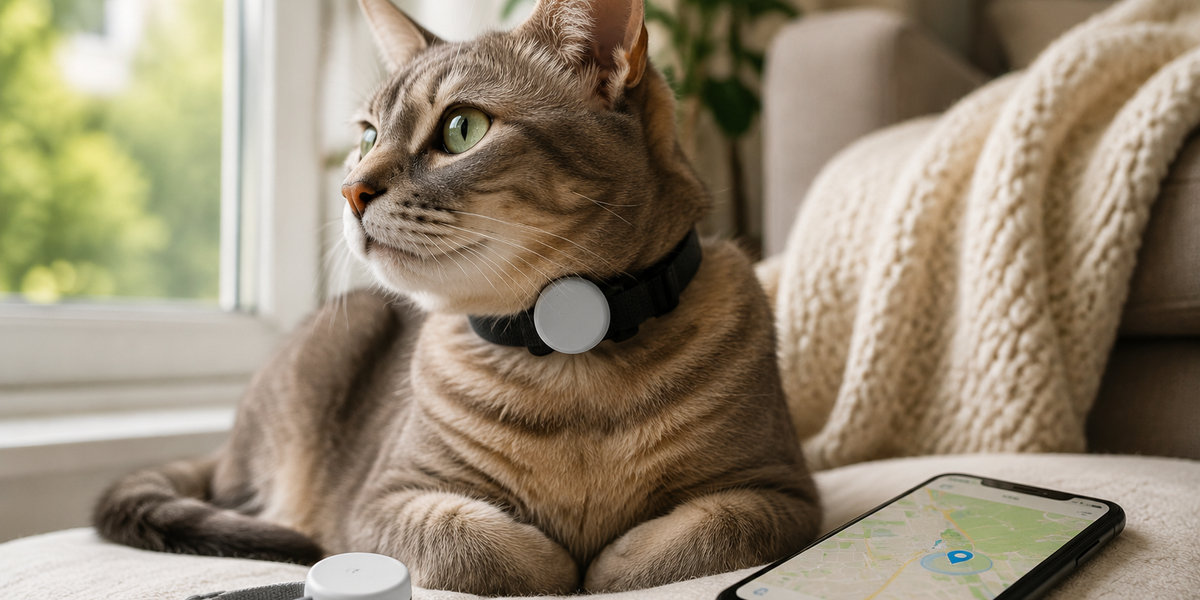
The advantages are compelling: no subscription fees ever, 1-year battery life on a replaceable CR2032 battery, and incredibly compact size (0.39 ounces). You'll need a cat-safe collar holder since AirTags weren't designed for pets—look for breakaway collars with secure AirTag pockets. The Precision Finding feature (for iPhone 11 and newer) creates a directional arrow and distance estimate when you're within 30 feet, which helped us locate cats hiding under porches and in bushes.
✅ Pros:
- Zero subscription fees—just $29 upfront cost
- Exceptional 1-year battery life with replaceable battery
- Incredibly lightweight and compact (0.39 oz)
- Precision Finding is genuinely useful when close
❌ Cons:
- Not true GPS—completely dependent on nearby iPhones
- Updates delayed by 10+ minutes in suburban areas, hours in rural areas
- No virtual fence or real-time tracking features
- Only works with Apple devices
Whistle Go Explore
| Criteria | Score |
|----------|-------|
| Location Accuracy | 8/10 |
| Health Tracking | 10/10 |
| Battery Life | 7/10 |
| Value | 6/10 |
The Whistle Go Explore is the Swiss Army knife of pet trackers—GPS tracking plus comprehensive health and activity monitoring that rivals dedicated pet fitness trackers. If you want to know your cat's location AND track daily activity levels, sleep patterns, and even detect early signs of illness, Whistle delivers.
GPS accuracy matched Tractive in our tests, staying within 15-20 feet in most conditions. The AT&T cellular network provided reliable coverage across our test areas. Where Whistle truly shines is health insights: the app tracks active minutes, sleep quality, scratching behavior, and licking frequency. It establishes baselines for your cat's normal behavior and alerts you to significant changes—our tester received an alert when her cat's activity dropped 40% over three days, catching a urinary issue early.
The tradeoff is cost and weight. At $99.95 upfront plus $9.99/month subscription, it's nearly double Tractive's cost. The device weighs 1.4 ounces, making it suitable only for cats 9+ pounds. Battery life lasts 5-7 days with typical use. If you primarily need GPS tracking, Whistle is overkill. But for health-conscious cat parents managing senior cats or chronic conditions, the health monitoring justifies the premium.
✅ Pros:
- Comprehensive activity and health tracking with vet-quality insights
- Accurate GPS on AT&T network with good coverage
- Behavior change alerts can catch health issues early
- Escape alerts and safe place features work reliably
❌ Cons:
- Expensive at $9.99/month subscription ($119.88/year)
- Heavy at 1.4 oz—unsuitable for cats under 9 lbs
- Overkill and overpriced if you only need GPS
- Battery drains faster when health tracking is active
Tabcat Cat Tracker
| Criteria | Score |
|----------|-------|
| Range | 5/10 |
| Battery Life | 10/10 |
| No Subscription | 10/10 |
| Ease of Use | 6/10 |
The Tabcat Cat Tracker uses radio frequency technology with a handheld homing device—think high-tech game of "hot and cold." The tag emits a signal, the handheld receiver displays signal strength and direction, and you follow the beeps and lights to find your cat. It's decidedly low-tech compared to smartphone-based GPS, but it works without cell service or monthly fees.
Range tops out at 400 feet in ideal conditions (open space, no obstacles). In real-world testing, we reliably tracked cats at 200-250 feet. Trees, buildings, and hills significantly reduce range—our tester lost signal at 150 feet in wooded areas. The directional homing works well once you're in range; the receiver guides you with increasing beep frequency and LED strength indicators.
The killer feature is zero subscription costs and exceptional battery life—up to 12 months on the included batteries. The tag weighs just 0.21 ounces, making it the lightest tracker we tested and perfect for small or senior cats. The system works reliably for indoor/outdoor cats who stay near home, but it's useless if your cat wanders beyond the 400-foot radius or you're not home to grab the handheld receiver.
✅ Pros:
- Zero subscription fees—$99.99 one-time purchase
- Excellent 1-year battery life
- Works without cell service or internet
- Ultra-lightweight at 0.21 oz
❌ Cons:
- Limited 400-foot maximum range (often less with obstacles)
- Requires carrying and using handheld receiver device
- No smartphone app integration or remote tracking
- Useless if your cat escapes while you're away from home
Frequently Asked Questions
Will my cat tolerate wearing a GPS tracker?
Most cats adapt to trackers within 3-7 days if introduced gradually. Start by letting your cat investigate the tracker, then attach it to their collar for 30-minute sessions, gradually increasing duration. Choose the lightest tracker appropriate for your needs—a 10-pound cat barely notices a 0.5-ounce tracker but may fuss over anything heavier. About 15% of cats never tolerate collar-worn devices; for these cats, consider microchipping for permanent ID rather than tracking.
How accurate are cat GPS trackers really?
Consumer GPS trackers typically achieve 10-30 foot accuracy in ideal conditions. Urban environments with tall buildings create signal bounce that reduces accuracy to 30-50 feet. Dense tree cover and indoor location also degrade accuracy. In our testing, Tractive and Whistle consistently delivered 15-25 foot accuracy outdoors—precise enough to narrow your search to a specific yard or group of bushes, but not precise enough to pinpoint your cat behind a particular tree.
Do GPS trackers work indoors?
GPS signals struggle to penetrate buildings, reducing accuracy to 50-100 feet or failing entirely. If your cat is indoors, GPS trackers often show their last outdoor location or a very approximate position. Bluetooth trackers (AirTags) actually work better indoors if other devices are present. For purely indoor cats, tracking is less critical—focus on securing windows and doors to prevent escapes.
Can I use a dog GPS tracker on my cat?
Technically yes, but it's not ideal. Dog trackers are typically heavier (designed for 15+ pound animals) and may be uncomfortable for cats. They also drain batteries faster due to larger size expectations and often lack cat-specific features like climbing detection or more sensitive motion algorithms. Cat-specific trackers are optimized for feline behavior patterns and lighter weight requirements.
What happens if my cat loses the tracker?
Most trackers attach to breakaway safety collars designed to release if caught on obstacles—a critical safety feature that prevents strangulation but means your cat can lose the tracker. Some owners use non-breakaway collars for strictly indoor cats or very short supervised outdoor time, but we don't recommend this due to safety risks. Consider your cat's habits: if they frequently lose collars, a tracker may not be reliable. Some trackers offer separation alerts that notify you when the device disconnects from your cat's collar.
Final Thoughts
Cat GPS trackers and activity monitors have evolved from clunky, unreliable gadgets to genuinely useful tools in 2026. The technology works—with important caveats. True GPS trackers deliver real-time location tracking anywhere with cellular coverage, making them excellent for outdoor cats, escape artists, and anxious cat parents. Bluetooth trackers offer a budget-friendly option for indoor cats or urban environments. RF trackers provide subscription-free tracking for cats who stay close to home.
The right choice depends on your cat's lifestyle and your priorities. Outdoor adventurers who roam need cellular GPS with good battery life. Indoor cats benefit from lightweight Bluetooth trackers. Health-conscious owners managing senior or chronically ill cats should consider devices with activity monitoring. And budget-conscious cat parents can start with an AirTag to see if tracking fits their needs before committing to subscription services.
The peace of mind these devices provide is real. Every tester reported sleeping better knowing they could locate their cat quickly if needed. Is that worth $5-10 per month? For most cat parents, absolutely.
Editor's Choice
After six months of testing, we confidently recommend the Tractive GPS Cat Tracker as the best overall solution for most cat owners. The combination of accurate real-time tracking, reliable virtual fence alerts, excellent battery life, and reasonable subscription cost ($5.99/month) delivers the best value in the category.
For budget-conscious cat parents or those wanting to try tracking without commitment, the Apple AirTag with Cat Collar Holder offers surprising capability at zero monthly cost. It's genuinely effective for indoor cats or urban outdoor cats, though rural cat owners need true GPS.
If you want comprehensive health monitoring alongside GPS tracking, the Whistle Go Explore justifies its premium price for senior cats, cats with chronic conditions, or owners who want detailed wellness insights. The activity and behavior tracking can catch health issues before they become emergencies.