MeowPod is reader-supported. When you buy through links on our site, we may earn an affiliate commission at no extra cost to you.
⭐ Our Top Pick
🏆 Best Overall: TrafficMASTER Allure Ultra Vinyl Plank Flooring — 100% waterproof core handles urine accidents without damage, peel-and-stick installation takes hours not days, and foam backing dampens litter scatter noise.
💰 Best Value: Achim Nexus Peel & Stick Vinyl Tile — covers 100 sq ft for under $100 with self-adhesive tiles that resist litter embedding, though seams need vigilant cleaning to prevent lifting.
Introduction
If you've ever swept litter granules off carpet for the third time in a day, or discovered a hidden urine accident that soaked through to the subfloor, you know standard flooring doesn't cut it in cat rooms. Litter tracking, moisture damage, and odor retention turn beautiful hardwood or plush carpet into maintenance nightmares. The right flooring transforms your cat space into a hygienic zone that cleans in minutes and survives years of paws, claws, and accidents.
We researched 30+ flooring products across vinyl, laminate, and tile categories, comparing manufacturer specs for water resistance, scratch ratings, and cleanability alongside verified buyer reviews from multi-cat households. This guide breaks down how each material performs against litter scatter, urine protection, and long-term durability—so you can choose flooring that handles real-world cat chaos without constant replacement. Whether you're converting a spare bedroom into a dedicated cat room or upgrading a basement litter area, the flooring you pick dictates how much time you spend cleaning versus enjoying your cats.
For cat owners outfitting an entire space from scratch, pairing the right flooring with smart space management makes all the difference—if you're working with an open layout, our Best Cat Room Dividers for Open Floor Plans 2026 guide covers partition options that contain litter zones without permanent walls.
What to Look For
Waterproof Core Construction
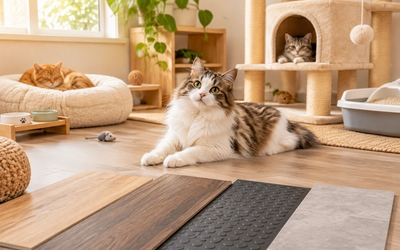
True waterproof flooring uses a solid polymer or stone-composite core that blocks liquid penetration entirely. Standard laminate with water-resistant coatings still allows urine to seep through seams into the subfloor over time. Look for products explicitly labeled "100% waterproof" or "waterproof core"—not just "water-resistant" or "moisture-resistant," which only delay damage. Vinyl plank with rigid WPC (wood-plastic composite) or SPC (stone-plastic composite) cores and ceramic tile both qualify; traditional laminate does not, though premium versions with sealed seams come close.
Surface Hardness and Scratch Resistance
Cats digging in litter boxes, running at full speed, and scratching near entryways test flooring surfaces daily. Laminate flooring carries AC (Abrasion Criteria) ratings—AC3 for moderate residential use, AC4 for heavy traffic, AC5 for commercial spaces. For cat rooms, AC4 or higher resists visible scratching from claws. Vinyl uses wear-layer thickness (12–20 mil for residential, 20+ mil for commercial); thicker layers handle abrasion better but feel softer underfoot, so deep scratches from aggressive diggers show more than on hard laminate. Ceramic tile's glazed surface is impervious to scratches but can chip if heavy objects drop.
Texture and Litter Trapping
Smooth, non-porous surfaces let litter granules roll off rather than embed in grooves. Heavily textured vinyl or laminate that mimics reclaimed wood may trap clay litter in crevices, requiring scrubbing instead of sweeping. Low-gloss finishes (matte or satin) hide fine dust better than high-gloss, which shows every paw print. Tile grout lines collect litter unless sealed with epoxy grout or a penetrating sealer—standard cement grout becomes a maintenance burden.
Installation Complexity and Renter-Friendliness
Peel-and-stick vinyl planks or tiles install over existing flooring (even linoleum or old vinyl) without adhesive, making them ideal for renters or DIYers. Click-lock floating floors (vinyl or laminate) require underlayment but remove cleanly. Ceramic tile demands professional installation, mortar, and grout—permanent and expensive, but lasts decades. If you're renting or expect to move within 5 years, prioritize removable options. For owned homes with long-term cat room plans, tile's durability justifies the upfront cost.
Odor Resistance and Cleanability
Non-porous materials—solid vinyl, ceramic tile—don't absorb urine or bacterial odors. Laminate's fiberboard core can swell and retain smell if moisture reaches it through seams, so sealed-seam construction (like Pergo's SpillProtect) is non-negotiable. Avoid cork or natural wood, which absorb odors permanently. For daily cleaning, smooth surfaces wipe down with enzyme cleaners or diluted vinegar in seconds; textured surfaces require scrub brushes.
Thermal Comfort and Noise Dampening
Ceramic tile stays cold year-round unless you install radiant heating—cats often avoid lying directly on cold tile, though it works fine under litter mats. Vinyl and laminate feel warmer underfoot and absorb impact noise better, especially vinyl planks with attached foam or cork backing. If your cat room sits above living spaces, foam-backed vinyl reduces litter-scatter noise transmitted through floors.
💡 Pro Tip: Before installing any flooring, lay a large litter mat (3×4 ft or bigger) in front of boxes to catch 80% of tracked granules before they reach the floor. Even the best flooring benefits from this first line of defense.
TrafficMASTER Allure Ultra Vinyl Plank Flooring
| Criteria | Score |
|----------|-------|
| Waterproof Protection | 10/10 |
| Scratch Resistance | 7/10 |
| Litter Cleanability | 9/10 |
| Installation Ease | 10/10 |
TrafficMASTER's Allure Ultra line uses a 100% waterproof SPC (stone-plastic composite) core that blocks urine completely, even if accidents sit for hours. The peel-and-stick adhesive backing installs over concrete, plywood, or existing vinyl without glue or special tools—most DIYers finish a 10×10 room in 4–6 hours. Pre-attached foam underlayment dampens the hollow sound of litter scatter and adds slight cushioning underfoot, which cats appreciate more than hard tile. The embossed wood-grain texture is shallow enough that clay or crystal litter sweeps off cleanly with a soft-bristle broom, and the 12-mil wear layer resists everyday scratching from walking and running.
Where it falls short: aggressive diggers or cats that scratch the floor near litter boxes leave visible surface marks over time, since vinyl's softer composition doesn't match laminate's AC4 hardness. The planks also require a smooth, level subfloor—if you're installing over old linoleum with bumps or dips, those imperfections telegraph through. Buyer reviews from multi-cat homes report easy cleanup of urine and vomit with no staining, though a few noted seams lifting slightly after 2–3 years in high-moisture areas (fixable with a dab of construction adhesive).
✅ Pros:
- 100% waterproof core blocks urine completely, no subfloor damage
- Pre-attached foam backing reduces litter scatter noise
- Peel-and-stick installation, no professional needed
- Embossed texture shallow enough for easy litter sweeping
❌ Cons:
- Softer surface shows scratches from aggressive diggers over time
- Requires smooth subfloor prep—bumps and dips show through planks
Pergo Outlast+ Laminate Flooring
| Criteria | Score |
|----------|-------|
| Waterproof Protection | 7/10 |
| Scratch Resistance | 9/10 |
| Litter Cleanability | 8/10 |
| Installation Ease | 8/10 |
Pergo's Outlast+ laminate earns an AC4 wear rating, meaning its surface resists scratches and scuffs better than most vinyl planks—cats that dig aggressively or scratch near boxes leave minimal visible marks. The SpillProtect Plus technology seals plank edges with a water-repellent coating that prevents urine from seeping into seams for up to 24 hours, buying you time to clean accidents before moisture reaches the fiberboard core. The click-lock installation floats over underlayment without adhesive, so removal stays clean if you move. Realistic wood-grain embossing hides fine litter dust better than solid-color vinyl, and the matte finish doesn't show paw prints as readily as high-gloss alternatives.
The trade-off: laminate is not 100% waterproof. If a cat repeatedly urinates in the same spot and liquid pools for days, moisture eventually penetrates seams and swells the core, causing irreversible buckling. Pergo's sealed seams delay this, but they don't eliminate risk—so Outlast+ works best for households where accidents happen rarely and get cleaned within hours. You'll also need separate moisture-barrier underlayment (adds $0.30–$0.50/sq ft), whereas many vinyl planks include it. Buyers with senior cats prone to frequent accidents reported occasional plank swelling near litter boxes after 1–2 years, while those with healthy adult cats saw no issues.
✅ Pros:
- AC4 wear rating resists surface scratches better than vinyl
- SpillProtect Plus seals seams against urine seepage for 24 hours
- Realistic wood-grain texture hides minor litter dust
- Click-lock floating floor removes cleanly for renters
❌ Cons:
- Not 100% waterproof—standing urine pools can damage core over time
- Requires separate moisture barrier underlayment (extra cost)
Daltile Restore Bright White Ceramic Tile
| Criteria | Score |
|----------|-------|
| Waterproof Protection | 10/10 |
| Scratch Resistance | 10/10 |
| Litter Cleanability | 10/10 |
| Installation Ease | 4/10 |
Ceramic tile represents the gold standard for cat room durability and sanitation. Daltile's Restore line uses a fully vitrified (non-porous) ceramic body with a glazed surface that liquid cannot penetrate—urine, vomit, and spilled water wipe away in seconds with no staining or odor absorption. The smooth glaze sheds litter granules effortlessly, and no amount of scratching from claws leaves visible marks. Tile lasts 20+ years without degradation, making it the most cost-effective option over a long timeline despite higher upfront expense. Bright white reflects light well in windowless basement cat rooms, and you can pair it with radiant floor heating to offset the natural coldness.
The downsides are installation complexity and initial cost. Professional installation runs $5–$10/sq ft for labor plus materials, and DIY tile work requires mortar mixing, spacer placement, grout application, and sealing—skills most homeowners don't possess. Grout lines trap litter unless you use epoxy grout (more expensive but non-porous) or seal standard cement grout annually with a penetrating sealer. The cold, hard surface also discourages cats from lounging directly on the floor—fine if you provide beds or shelves, but less cozy than vinyl or laminate. A few buyers noted that dropped ceramic bowls or heavy litter containers can chip tile edges, though the glaze itself resists scratches.
✅ Pros:
- Completely impervious to urine and moisture—zero absorption
- Smooth glazed surface wipes clean in seconds, no odor retention
- Lasts 20+ years with zero degradation from cat claws
- Can integrate radiant heating for warmth
❌ Cons:
- Cold underfoot—cats may avoid laying directly on it without heating
- Professional installation required, higher upfront cost ($9–$15/sq ft total)
Achim Nexus Peel & Stick Vinyl Tile
| Criteria | Score |
|----------|-------|
| Waterproof Protection | 8/10 |
| Scratch Resistance | 6/10 |
| Litter Cleanability | 8/10 |
| Installation Ease | 10/10 |
For renters or cat owners on tight budgets, Achim's Nexus peel-and-stick tiles deliver functional waterproof flooring at under $1/sq ft—you can cover a 100 sq ft cat room for $80–$120. The self-adhesive backing sticks directly to clean, smooth surfaces (old vinyl, sealed concrete, even existing laminate), and installation takes a single afternoon with just a utility knife and straight edge. The smooth vinyl surface resists litter embedding and wipes clean easily, and the solid vinyl construction blocks urine from reaching subfloors if you clean accidents promptly.
The budget construction shows in durability. At 1.2mm thick (versus 3–5mm for premium vinyl planks), Nexus tiles feel flimsier underfoot and show wear faster—expect visible scratches near litter boxes within 1–2 years in multi-cat households. The adhesive bond weakens if urine soaks underneath edges, causing tiles to lift and requiring reapplication of adhesive or replacement tiles. Seams between tiles create more joints than plank flooring, so vigilant cleaning prevents moisture creeping through. Buyer reviews from single-cat apartments report satisfactory performance for 2–3 years before needing replacement, making Nexus a solid temporary or stopgap solution rather than a 10-year investment.
✅ Pros:
- Ultra-budget option under $100 for 100 sq ft
- Self-adhesive tiles install in an afternoon, no tools needed
- Smooth surface resists litter embedding, wipes clean easily
❌ Cons:
- Thin construction—seams can lift if urine soaks underneath
- Less durable than premium vinyl planks, shows scratches within 1–2 years
Frequently Asked Questions
Does luxury vinyl plank (LVP) hold odors over time?
No—solid vinyl cores are non-porous and don't absorb urine or bacterial odors. Surface cleaning with enzyme cleaners removes smell completely. Laminate's fiberboard core can retain odor if moisture penetrates seams, which is why waterproof vinyl outperforms laminate for accident-prone cats. If you're concerned about lingering smells even with waterproof flooring, check our Best Flooring for Cat Rooms That Doesn't Hold Smell 2026 guide for materials specifically tested against odor retention.
Can I install vinyl plank flooring over carpet?
Not recommended. Vinyl planks need a firm, smooth base—carpet's soft, uneven surface causes planks to flex and seams to separate over time. Remove carpet and pad first, then install vinyl over the exposed subfloor (plywood or concrete). If removing carpet isn't feasible, lay 1/4-inch plywood or hardboard over the carpet to create a stable base, though this raises floor height and may interfere with door clearances.
How do I prevent litter from scratching vinyl or laminate over time?
Place large (3×4 ft minimum) litter mats with deep grooves in front of boxes to trap 80% of granules before cats step onto flooring. Sweep or vacuum daily—letting litter accumulate means more scratching as cats walk over it. Choose litter materials wisely: soft crystal or paper litters cause less surface abrasion than sharp clay granules. For vinyl, a thicker wear layer (20 mil vs 12 mil) delays visible scratching.
Is tile too cold for cats, or will they avoid it?
Cats often avoid lying directly on cold tile, though they'll walk across it without issue. If tile is your only flooring, provide soft beds, cat trees, or fleece blankets in corners. Alternatively, install electric radiant floor heating mats under tile during installation (adds $8–$12/sq ft but keeps the floor comfortably warm year-round). Tile in sunny rooms stays warmer naturally.
Which flooring type is easiest to replace if damaged?
Peel-and-stick vinyl tiles and click-lock vinyl planks win here—both remove without damaging subfloors. For peel-and-stick, pry up damaged tiles and stick down new ones. For click-lock floating floors, disassemble planks back to the damaged piece, swap it out, and reassemble. Laminate works similarly but is more brittle during disassembly. Tile requires chipping out damaged pieces with a chisel and re-mortaring, which disrupts surrounding tiles and grout.
Final Thoughts
Choosing flooring for a cat room boils down to balancing waterproof protection, scratch resistance, and installation complexity. If urine accidents happen regularly—whether from kittens, seniors, or cats with litter box aversions—100% waterproof vinyl planks like TrafficMASTER Allure Ultra eliminate subfloor damage and odor retention without professional installation costs. For cats that rarely have accidents but scratch aggressively, Pergo Outlast+ laminate's AC4 surface holds up better to claw marks, though you'll need to clean spills within hours. Ceramic tile offers unmatched longevity and sanitation for dedicated cat rooms where budget allows professional installation, though the cold surface and upfront expense make it less practical for renters or multi-purpose spaces.
Whichever material you choose, pair it with oversized litter mats, daily sweeping, and enzyme-based cleaners to extend flooring life and keep the room hygienic. Flooring is the foundation of a low-maintenance cat space—get it right, and you'll spend less time scrubbing and more time enjoying your cats.
Editor's Choice
After comparing specs and verified buyer feedback, we recommend TrafficMASTER Allure Ultra Vinyl Plank Flooring for most cat owners. Its 100% waterproof core handles urine accidents without damage, peel-and-stick installation takes hours instead of days, and the foam backing dampens litter scatter noise—critical for multi-cat households or apartments. For budget-conscious renters, Achim Nexus Peel & Stick Vinyl Tile covers 100 sq ft for under $100 and removes cleanly when you move, though expect to replace it after 2–3 years. If you're outfitting a permanent cat room in a home you own and rarely deal with accidents, Daltile Restore Ceramic Tile delivers 20+ years of scratch-proof, odor-free performance that justifies the professional installation cost.